Susan Buck-Morss: Hegel's Dialectic in the Shadow of Haiti
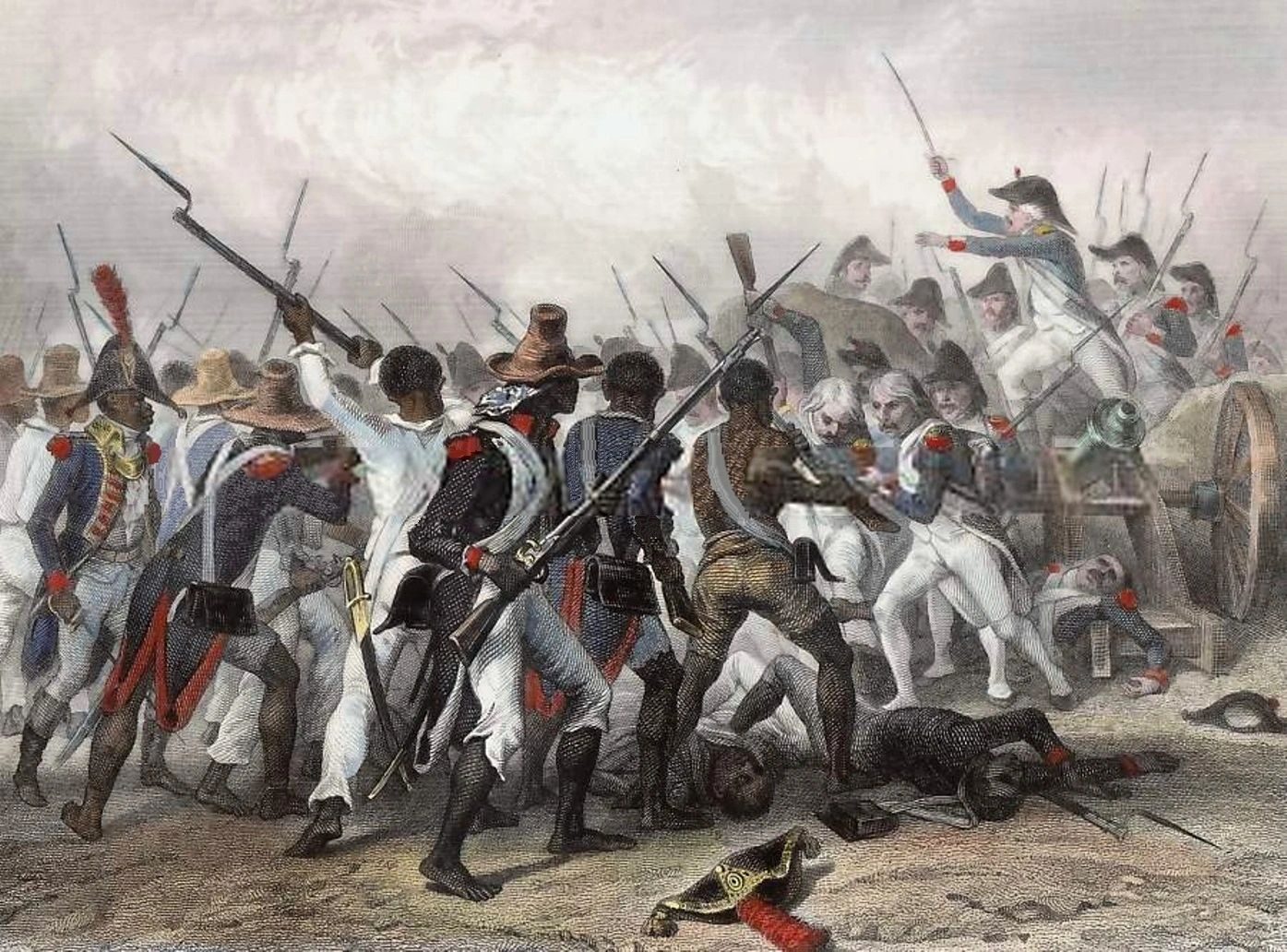
Georg Wilhelm Friedrich Hegel is a notoriously cryptic thinker with an equally difficult body of work. Hegel’s thought, reception, and usages have been debated nearly ad nauseam. For example, disagreements over how to read his racialized descriptions of non-European peoples, places, and civilizations are contentious to say the least. Hegel’s description of Africa as an “unhistorical continent” has, and continues, to provoke criticism, and understandably so. Nonetheless, an old maxim remains true - wisdom is the lost property of the believer. Put otherwise, wherever one finds something beneficial, take it. There remains much one can lift from Hegel. Nonetheless, how to read Hegel in the twenty-first century is not a straightforward affair and requires a fair amount of careful attention.
Phenomenology of Spirit (1807) remains, probably, Hegel’s best-known text. It’s most (in)famous chapter- Herrschaft und Knechscahft – establishes the Lord and Bondsman dialectic as central to Hegel’s entire system. Elsewhere translated as the master-slave dialectic, this fundamental Hegelian concept involves a struggle for recognition. The lord, through domination, achieves a hollow mastery over and dependence upon the bondsman. Through labor and a confrontation with death, the bondsman ultimately attains genuine freedom and self-consciousness over and against their master.
In a groundbreaking essay, “Hegel and Haiti” (2000), later expanded into Hegel, Haiti, and Universal History (2009), Prof. Buck-Morss wades into this thorny debate. She argues that Phenomenology’s Lord and Bondsman dialectic is not merely an abstract exercise in idealist thought. Rather, Hegel’s dialectic was shaped by concrete historical events, the Haitian Revolution. As she writes, “Hegel knew—knew about real slaves revolting successfully against real masters, and he elaborated his dialectic of lordship and bondage deliberately within this contemporary context.” In making this case, Hegel, Haiti, and Universal History also casts readers' attention to another consideration - the nature of and relationship between philosophical concepts, abstract thought, and material reality.
In what follows, Prof. Buck-Morss explores the relationship between Haiti, France, and their respective revolutions in Hegel’s thought. In doing so, readers are taken through Hegel’s celebration of the Bastille’s storming, dialectics, and the possible import of a Caribbean uprising for the understanding of human freedom. Hegel is complicated. So too is reading him centuries after his death. Nonetheless, perhaps it is true that philosophical concepts possess two wings - one in the material world, another in the world of ideas. A bird can only fly with both.
celebrate-a-storming|kant|universal-freedom
Hegel was only 19 years old when the Storming of the Bastille took place on July 14, 1789, and this liberation of political prisoners by revolutionary insurrectionists affected him greatly. It is known that he and friends drank champagne on this occasion to celebrate the event. William Wordsworth, born the same year as Hegel (1770) wrote famously of those days: “Bliss it was to be alive, and to be young was heaven!” All of Europe (at least the young) was moved by the revolutionary idea of popular sovereignty and transforming the society of feudal relations based on hierarchical differentiations. It was this revolutionary spirit that caused excitement generally when Europeans received the news of the outbreak of revolution on the French island of San Domingue. The journal Minerva (which we know that Hegel read) published detailed coverage of the events, declaring: “the eyes of the world are now on St. Domingue!” These reports included not only the abolition of slavery in 1793, but the island’s declaration of independence from France and the founding of Haiti in 1804 on the principle of universal freedom for all inhabitants.
Hegel’s model, building on Kant’s “Copernican turn” in philosophy, was to discover abstract, general laws that enabled a scientific understanding of human historical processes. The latter (unlike Kant’s model of the natural sciences) were defined by change, and human consciousness had agency in producing that change. Dialectical “laws” of historical change referred to the general developmental tendency: human consciousness, reflecting on the real, objective conditions, used principles of universal reason to protest against these conditions and affect their change. This process of bringing reality into correspondence with reason was Hegel’s understanding of human “freedom” as the leitmotif of universal history.
lordship-bondage|dialectics|haiti
The French and Haitian revolutions were totally entwined. In order to understand the nature of their connection it is necessary to consider the economic factors underlying these political acts. The political ideas of these revolutionaries were shared. The economic relation between them were diametrically opposed in one fundamental way. The Caribbean slave economies of plantation production produced the wealth of the rising bourgeois class of Frenchmen who were replacing the feudal class of landed estates within France. And (as Marx observed), economic forces proved determining. Post-revolutionary France, from Napoleon to the Bourbon Restoration (c. 1814), fought against the claims of the Haitian Republic, and hobbled the latter’s attempts at national independence for generations to come.
The Haitian Revolution was more visionary. The French Revolution used “slavery” as a metaphor for political domination. But the Haitian revolutionaries rebelled against really existing slavery on the Caribbean plantations, an institution of forced labor that was becoming foundational to capitalist imperialism as a modern economic form.
Hegel was really trying to understand his time. The history of Haiti, he knew, was of major significance for comprehending what, in the Phenomenology of Spirit, he calls “the birth of a new era.” He was young, he didn’t have a job, he was advocating for the radical French revolutionary ideas just as Germany was fighting against Napoleon, whose troops entered his university town of Jena as he was finishing the writing of this work. I do believe that the mature Hegel, the fifty-year-old Berlin professor who became the leading German philosopher, training bureaucrats for the Prussian state, tempered his political support of revolutionary change. But Hegel’s own changing opinions do not interest me as much as the way European contemporaries of the Haitian Revolution recognized this event as an expression of the universal desire of human beings for freedom, not limited to Europeans, but transcending national boundaries and cultural differences.
phenomenology-haiti|consciousness-political-act
[Situating Hegel’s “lordship and bondage” dialectic alongside the Haitian Revolution changes our reading of Phenomenology of Spirit (1807) and] allows us to better understand the importance of objective, economic conditions in determining political outcomes in our own time. Marx, as Hegel’s student, saw this clearly, whereas Hegel himself did not. In his early writings, Marx praised Hegel for recognizing the fundamental importance of human action (Tun), but he criticized the fact that the only action Hegel understood was “abstract mental labor” –the “actions” of the thinking philosopher rather than working people.
We need to pay attention not only to what is rendered invisible, but also to what the consequences of this blindness are. When, in the 19th century (under Hegel’s influence), national histories were written as the model for remembering the past, global stories like the Hegel-Haiti connection got lost. Bringing them back into consciousness becomes a political act, a move in our time toward a universal history of humanity worthy of the name.

Susan Buck-Morss is a Distinguished Professor of Political Theory and a core member of the Committee on Globalization and Social Change at the CUNY Graduate Center. She holds the title of Jan Rock Zubrow ’77 Professor Emerita of Government at Cornell University, where she was a member of the graduate fields of Comparative Literature, German Studies, History of Art and Visual Studies, Romance Studies, and the School of Art, Architecture, and Planning. Her book Revolution Today appeared in 2019 (Haymarket Press). Her new book YEAR 1: A Philosophical Recounting was published in April 2021 by The MIT Press.