Essays06
Never Fully Formed, Never Truly Broken
Badr Sellak
Casablanca lives between the dream of a city and the reality of dwelling.
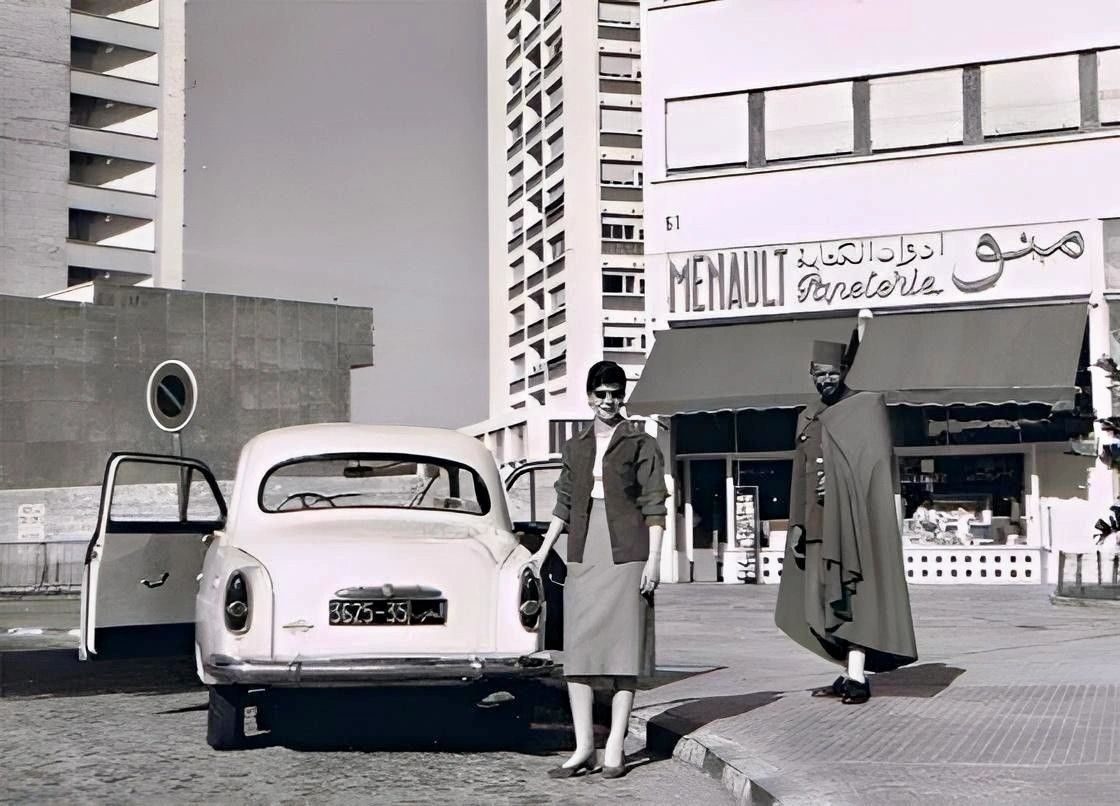
Casablanca is built on the banks of a river. It nearly drowns with every rain. Despite ordered façades, nothing fits. The city has always been appropriated, reshaped, and repurposed by its inhabitants. The medina’s ghosts constantly rework and rebuild it. Historical buildings have been repeatedly sacrificed to make room for “progress” – sometimes in efficiency’s name, other times on the altar of neoliberalism. Old monuments have crumbled amidst intermittent development and sleek high-rise buildings.
For decades, Mohamed V Boulevard has been a living poster for taste and refinement. The street stretches into a paved walkway with neo-mauresque buildings. Mohamed V’s galleries are shaded by vast arcades, and beautifully etched balusters overlook promenades. With Casablanca's expansion, the boulevard became a quaint gathering spot for old timers, overlaid with devaluing real estate. Mohamed V still generously hosts a collection of humidity-ridden attics, and flocks of vacant apartments contested in inheritance.
From downward development, disputed inheritances, and damp vacancies, Casablanca’s boulevard longs for its glorious past that inspired Marcel Carné’s lavish scenes. Haunted by romanticization and re-appropriation simultaneously, Casablanca is best enjoyed in the past tense. The closest thing to an ideal can only be re-assembled from fragments.
This rigid separation of the colonial ville nouvelle from the city’s indigenous quarters still lingers in the collective memory, where progress and erasure remain inseparable.
Throughout the 1930s and 1940s, migratory influxes of rural families and young working men poured into Casablanca’s “bidonvilles.” A residential moniker that owes its provenance to the storage drums from the port (Bidons) used to construct a makeshift shelter. Out of barrels and farmers, Casablanca expanded mainly by sprawl. Shantytowns and huddles of small concrete-block houses created what French architect Michel Ecochard described as a “mushroom-city, bereft of any planning.”
Ecochard, Casablanca’s 1950 urban planner, introduced both a blueprint for social housing and a model for the modern Moroccan home. Drawing from the medina’s old stone buildings and narrow cobbled streets, and guided by modernist planning’s rational design, Ecochard built the new setting for the masses of Moroccans migrating towards the city, supplying shelter for the greatest number. “Trame Ecochard” was born.
Buildings with a central courtyard were erected on grids intersected by alleyways and pathways linking the different apartments. Individual trames consisted of three-room, 8x8m apartments with a central courtyard. Called unité de voisinage, each neighborhood cluster housed about 1800 inhabitants. Every 5 units formed a quartier of up to 9000 people. These units had it all - mosques, souks, schools, and other essential amenities. Or, at least that’s how they were marketed. Ecochard’s designs were logical on paper, pragmatic even. They expressed concern about decent housing for the largest number.
Yet, for all its ambition, “trame Ecochard” collided with a city where necessity rewrote the rules. Early models of social housing “renovated” by its residents, responses to sociological mismatch. Top-down planning that failed to align with bottom-up needs. Modified trames slowly began to resemble the ad-hoc barrel houses of pre-Ecochard Casablanca.
The superstitions of the ancestral land jutted against the modern and optimized planning of modern architecture and the new marks of social divide.
Previously autonomous land-based communities fled desolate hinterlands, resettled in standardized modern housing units, and joined an industrial urban workforce. This microcosm inspired the social critique of Casablanca’s early visual culture. Jaafar Akil, Mohammed Mali, and other members of the photo reportage movement saw in the city’s raw texture a fractured cityscape. The gritty atmosphere of Reguab or Maanouni’s depiction of urban divide or the composite portraits in Derkaoui’s street narratives laid bare these tensions.
Out of the public outcries of working-class youth and disillusionment with post-independence, the Ghiwane movement was born on the streets of Hay Mohammadi. Visual artists like Melehi, Chebaa, and Agueznay made public spaces a canvas where avant-garde struggles of decolonizing art through local heritage played out. Through public exhibitions, mural paintings, and design work on objects and installations for public infrastructure, these artists decried their exclusion by elitist art and its institutions. They pleaded for more participatory street-level praxis.
Casablanca became a public canvas where artists and dwellers alike shattered the divide between art contained in institutions and art embedded in everyday life. These movements sought to dissolve this boundary, forging spaces where the avant-garde would become part of everyday discourse. Even today, graffiti, large-scale murals, and freshly repainted façades stand alongside institutional efforts to revive old structures as a reminder that resistance in Casablanca has always been spatial.
Casablanca becomes a mild-weathered enclave on the shore with ancient oceanic feels and welcoming people.
At the turn of the 1990s, several things happened at once. Early neoliberal reforms evoked a new, lush, orderly Casablanca. Sleek modern buildings replaced old tenements. Satellite dishes sprouted like weeds. Goods were increasingly imported; an internet cable was laid. Unfazed by their parents’ urban resettlement, Casablanca’s first-generation urban natives found themselves disillusioned by the bleakness of neoliberalism's newfound idealism.
Casablanca became a brand. Its trademark was a delicate marriage of lively family walkways and beachside bungalows. Nightlife excursions were marked by neon flickers and curated art installations. Daniel Rivet aptly describes this phenomenon as an archipelago-city: a fractured, provisional entity accommodating divergent social groups and disparate functions. As an archipelago-city, Casablanca delimited residents within their own territories, leaving in their wake very little continuity.
Casablanca’s neighborhood facelifts left a void. Pushing the city’s perceived undesirables to the outskirts, slowly chipping away at what made the city somewhat tolerable. Its cultural footprint on the aesthetic flattens into exhibition, where the past becomes displayed. Casablanca’s deepest truth is that it was never meant to be coherent. Casablanca was never designed to be fully formed, never fully broken. Casablanca is an open system, an improvisation of a city in the cracks of the masterplan, a plastisphere.
Beneath these narratives, Casablanca persists in the cracks. It lies in the gray areas where the crawl of invasive urban growth becomes more prominent against grid alignments and perspective lines. The clash of memory and ambition, of beauty in ruin.
BIBLIOGRAPHY
Rochd, Nabil. “Une métropole portuaire d’Afrique du Nord : Casablanca. Explosion urbaine et planification.” Les Annales de la recherche urbaine, no. 46, 1990, pp. 113–118. DOI: 10.3406/aru.1990.1515
Écochard, Michel. Casablanca : le roman d'une ville. Paris : Éditions de Paris, 1955.
Rouissi, Karim. “Housing for the Greatest Number: Casablanca’s Under‑Appreciated Public Housing Developments.” Journal of North African Studies, vol. 26, no. 3, Nov. 2019, pp. 1–26. doi:10.1080/13629387.2019.1692411
Rivet, Daniel. Le Maroc de Lyautey à Mohammed V : Le double visage du Protectorat. Paris: Denoël, 1999.
Badr Sellak is a freelance writer and journalist based in Casablanca, Morocco. His essays explore changing identities in emerging independent art scenes and the cultural dynamics shaping North African societies.