Essays09
The Saint and the Sultan
Abdullah Yesilcay
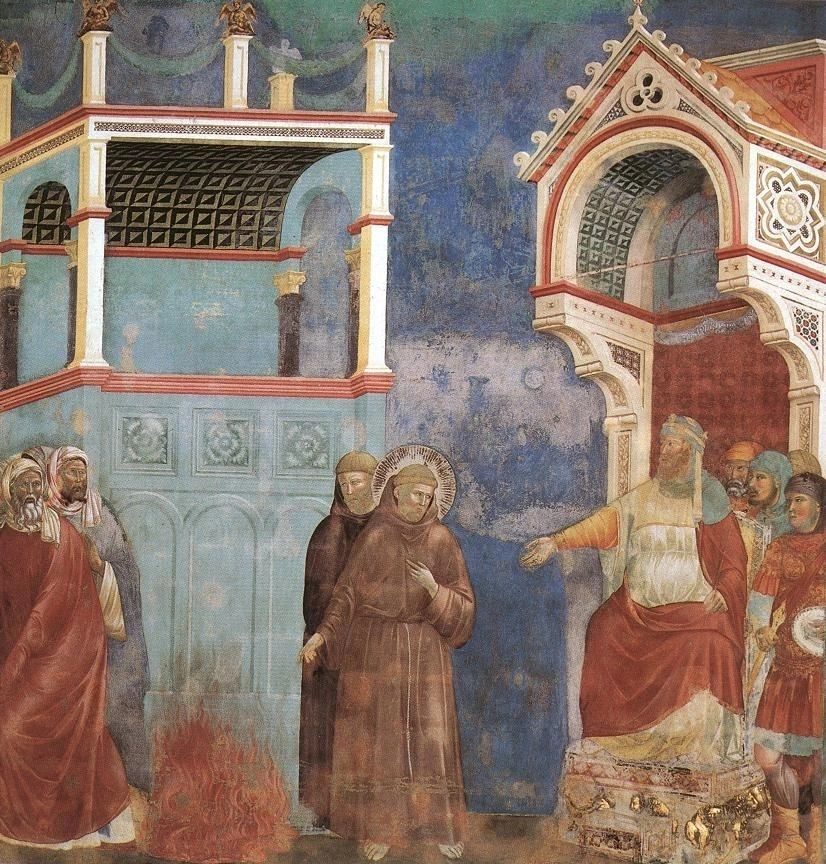
As chants of "Deus vult" (God wills it) echoed through the Crusader camp, a humble friar set out on a one-man peace mission. In the year 1219, amid the Fifth Crusade, Francis of Assisi crossed unarmed into Sultan al-Malik al-Kamil's camp in Damietta. While thousands of Crusaders ventured into Muslim lands to kill and conquer, Francis carried neither sword nor malice. He approached the Sultan with a bold yet seemingly naïve hope: to convert him to Christianity. However, the encounter perhaps worked in reverse. The Islamic world left its mark on this Catholic monk, which would later lead to the creation of the Italian spiritual songs collected in the Laudario di Cortona.
After Francis returned to Italy, the Franciscans' Regula Bullata received papal approval, and the order’s eponymous founder introduced religious songs outside of ecclesial settings. Unlike Gregorian chant with its necessarily sacral context, Francis’ songs were meant for the people.
Importantly, Francis’ music wasn't new to medieval Europe. Troubadours and Minnesänger were already traveling the lands with their instruments and singing to the people. Initially emerging in what is today France, this musical tradition rapidly spread and became popular across Europe. The music had a strong power over people and became one of the earliest forms of propaganda music. For example, the Palästinalied by Walther von der Vogelweide spread Crusader propaganda, and the Spanish Cantigas de Santa Maria, despite their religious nature, still depicted Jews and Muslims negatively.
Interestingly, none of the Franciscan songs contains even the slightest amount of similar hate. Its text-content, mostly praising Mother Mary, is spiritual rather than polemical.
These songs are an important part of European shared cultural heritage, found in almost all Western Catholic countries. Nonetheless, their origin remains mysterious. Apparently, almost out of nowhere, emerges a highly developed musical and lyrical form, with new instruments like the lute and the rebec.
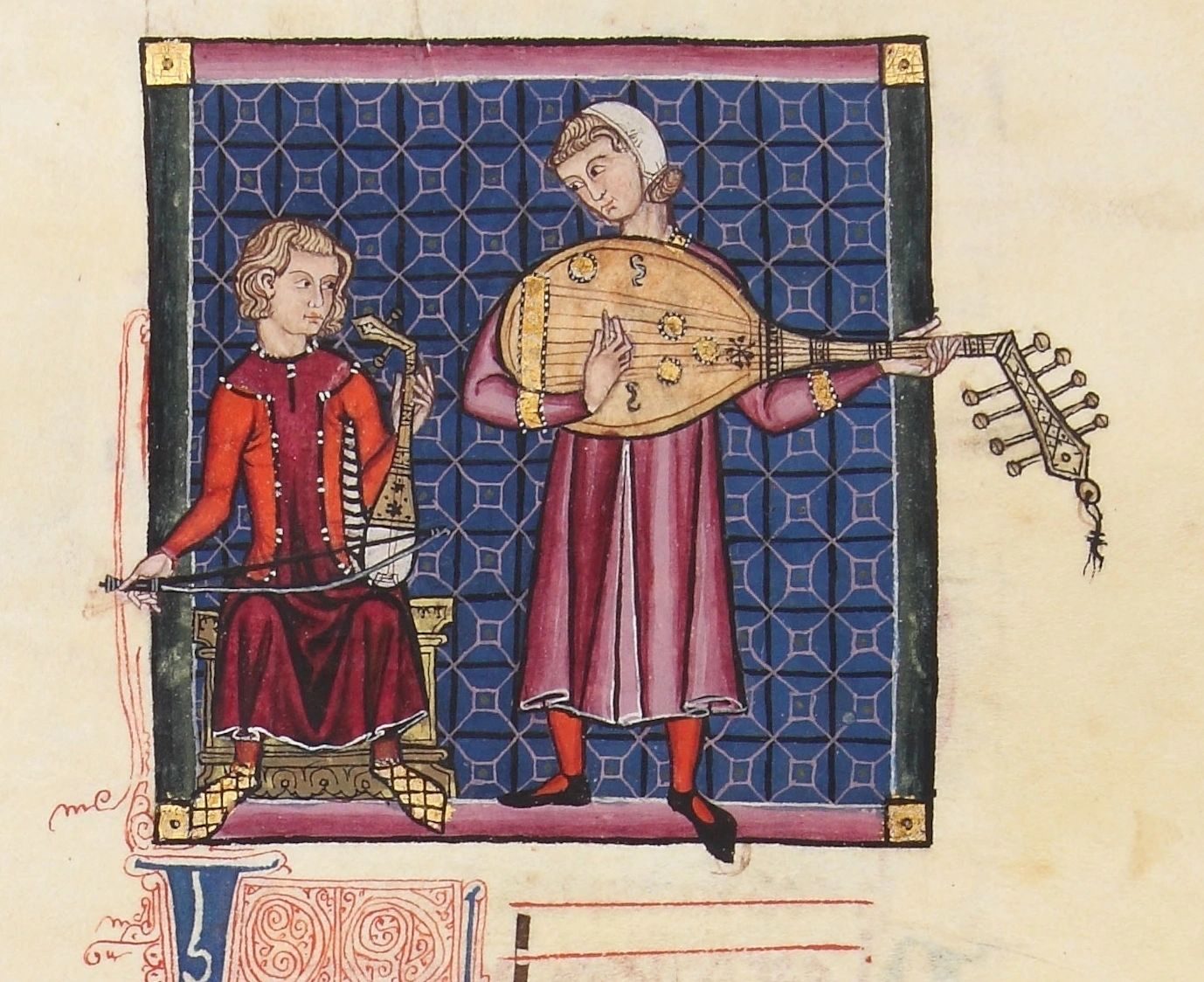
Indeed, these instruments offer a hint at the origins of these songs. In Andalusia, one finds the Oud and rabāb, a form of musical performance, and, in fact, the same song form.
The zajal, a form of strophic poetry and the less formal version of the muwashshah, was a blueprint for the songs of the troubadours and later those of Francis and his followers. A zajal’s characteristic trait is its rhyme structure, which in its basic form goes:
AA bbba ccca …
Zajal by Ibn Ghuzman
Yā man idhā rā'it jānī farḥī
Lā budda min kabshin mā naḍī
Las nabqu khāyib min iḥtibālik
Wa-l-amru lā shakka maktūb fī bālik
A'ūdhu bi-llāhi wa-bi-jalālik
Law an yakūna ismī min maḥī
Lauda from Francis's Laudario di Cortona
O divina virgo, flore
aulorita d'ogne aulore!
Tu se' flor che sempre grane,
molta gratia in te permane:
tu portasti 'l vino e pane,
cioè 'l nostro redemptore.
This musical tradition has long been lost to us. The songs, just like much Eastern music, are part of an oral tradition, and not many tracks were written down. And those that have been preserved in old handwritten manuscripts offer little information on how they are supposed to be sung and played, or even on rhythm.
However, with the similarity in instrumentation and lyrical structure to Eastern music, it seems rather obvious how they should be played. Listening to the cantigas and laude, a shared heritage with Arabic music can be felt. Combined with the proximity of the birthplace of medieval European song to al-Andalus, it is clear these songs bear an unmistakable Eastern influence.
Nonetheless, Francis's songs are special. The Laudario di Cortona, which collects 47 songs by Francis and his followers, has two connections to the Muslim world: Al-Andalus, which brought this form of music to Europe and the Ayyubid Sultanate, where he lived and slept among Muslims.
The Pera Ensemble caught the Arabic essence of the laude. There are numerous recordings of Francis's songs, but many fail to see their Eastern deposit. Perhaps the idea that Muslims could have influenced Western culture still sits uncomfortably with many of our traditional narratives.
Some scholars, like Clemente Terni argue that the Laude di Cortona should be performed in the style of Gregorian plainchant, citing the fact that they were carried in square black notation, the standard script of medieval liturgical music. Yet this reasoning conflates medium with message. It is the equivalent of insisting that classical lieder and jazz standards must be sung in the same tradition simply because both are written in modern staff notation. Sharing a script does not mean sharing a voice.
The notation of the period was, by its very nature, incomplete. It could not capture the living breath of a melody, its rhythm, its ornamentation, its improvisational freedoms. It functioned less as a score and more as a skeleton: a bare outline onto which performers were expected to breathe life. That this was indeed the case is suggested by Lauda No. 10 (O Maria, d'omelia), in which the same melody appears in four distinct variants, not as errors, but as traces of a vibrant oral tradition in the process of being written down for the first time.
Medieval Illuminated manuscripts and frescoes frequently depict laudesi singers alongside frame drums, lutes, and fiddles, while contemporary accounts of the Laudesi brotherhoods paint a picture of lively, popular devotion, far removed from the restrained atmosphere of plainchant.
In the end, it's only a guess how these pieces were really performed, and it's left to readers to listen to these songs themselves and decide whether a connection between East and West can be heard. But to me, the Laudario, with its history and meeting between the Sultan and a friar, bridges Orient and Occident, and is a lesson for Muslims and for all those who were once colonized.
At one point in history, a Catholic saint learned from Muslim musicians.
Works Cited
Ciliberti, Galliano. “Tracce di tradizione orale nel Laudario ‘Cortona 91’.” Musica e Storia 8, no. 1 (2000): 265–306.
Kermani, Navid. Wonder beyond Belief: On Christianity. Translated by Tony Crawford. Cambridge: Polity Press, 2019.
Marchi, Lucia. “St. Francis and the Sultan: A Sonic Encounter.” Archivio Italiano per la Storia della Pietà 32 (2019).
Quartetto Polifonico Italiano. Laudario di Cortona: Codex 91 of the Etruscan Academy of Cortona (13th Century). Transcribed by Clemente Terni. Musical Heritage Society MHS 858, 1968. Accessed June 10, 2026. https://archive.org/details/lp_musica-italica-laudario-di-cortona-codex-9_quartetto-polifonico-italiano.
Terni, Clemente. “Per una edizione critica del Laudario di Cortona (codice 91 dell’Accademia Etrusca di Cortona).” Chigiana 21 (1964): 111–129.
Yesilcay, Mehmet Cemal. “1219: The Saint and the Sultan.” Pera Ensemble. December 10, 2023. https://pera-ensemble.com/en/programm/franz-von-assisi-und-sultan-al-kamil-die-geschichte-hinter-1219-the-saint-and-the-sultan/.
Abdullah Yesilcay is a musicologist, born and raised in Munich with Turkish heritage, striving to harmonize his dual identities, following in his father's footsteps by bridging the cultural and musical divides between East and West, with a particular focus on ethnomusicology.