Essays23
Moroccan Madrasa as a Barzakh Space
Ali Salama
an intermediate world standing between the luminous or spiritual world and the dark or corporeal world…neither spiritual nor corporeal but somewhere in between.
-William Chittick
–
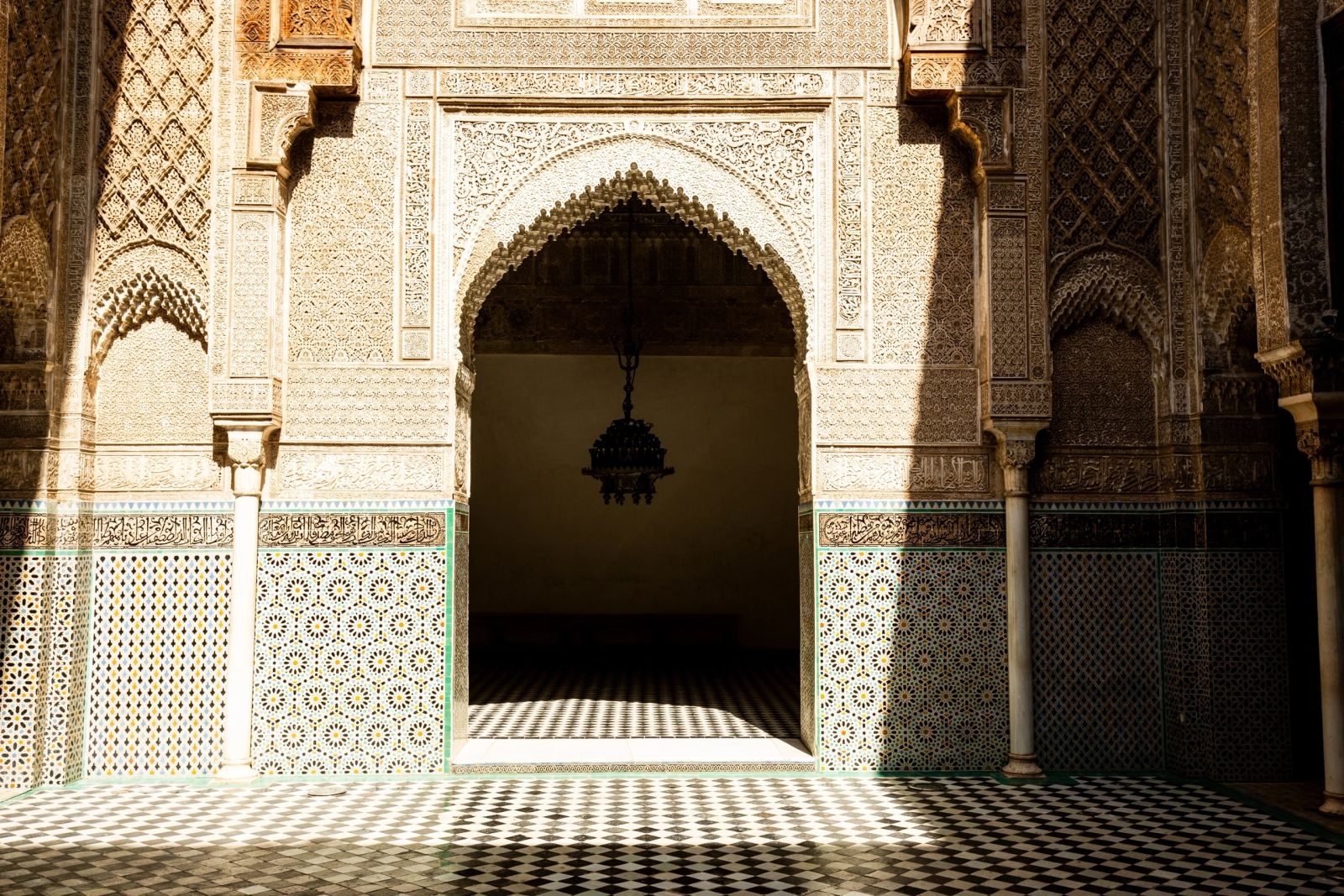
…Push open the door. The courtyard floods the hallway. Forgotten is the medina and the souq, the noise, the heat, and the crowds. Inside, time feels slower and one’s attention sharper…
–
Fes’s El Attarine madrasa was completed in 1357. It is one of the most compelling architectural examples of space as barzakh. Tucked deep inside the Fes medina, past the bustling souq el Attarine, the school hides inconspicuously in plain sight. Inside, every surface of its courtyard is intricately decorated with carved cedar, chiselled stucco, and glazed Zellige tiles. Its incredibly tactile surfaces seem to hide something more. The more one looks, the more there is to see. The madrasa’s walls, draped in sacred geometries and divine motifs, set the entire space in ever-changing motion. In the middle of the courtyard, a fountain flows softly, keeping the rhythm. The space radiates a sense of stillness, peace, and alignment. El Attarine madrasa is a liminal space, between the divine and the worldly, the spiritual and the sensory, the sacred and the profane. It exists simultaneously in the material world and in an imaginal plane.
Quranically, barzakh is used to describe a barrier where two seas meet:
وَهُوَ ٱلَّذِى مَرَجَ ٱلْبَحْرَيْنِ هَـٰذَا عَذْبٌۭ فُرَاتٌۭ وَهَـٰذَا مِلْحٌ أُجَاجٌۭ وَجَعَلَ بَيْنَهُمَا بَرْزَخًۭا وَحِجْرًۭا مَّحْجُورًۭا
“It is He Who has let the two bodies of flowing water: One palpable and sweet, and the other salt and bitter. Yet has He made a barrier (barzakh) between them, a partition that is forbidden to be passed” (Quran, 25:53).
In ontological terms, the two bodies of water are two polarities of being: the clay of Adam and the Ruh (divine spirit) breathed into him, both our worldliness and our divineness.
Ibn al-Arabi understood the two seas as a gulf of sensory being and an ocean of meanings. He comments, “there are never two opposite things, unless there is a barzakh between them, which they do not overpass…The barzakh is like a dividing line between existence and non-existence. It is neither existent nor non-existant.” (Chittick, Sufi Path 123). Barzakh separates the two seas. And, it is their meeting threshold.
The sea is both salty and sweet, palpable and bitter. Yet, somehow also neither. Ibn al-Arabi explains, “the sensory thing cannot be a meaning, nor can the meaning be a sensory thing. But the [barzakh] embodies meanings and subtilizes the sensory thing. It transforms the entity of every object of knowledge in the viewer’s eye” (Chittick, Sufi Path 123). Within the barzakh, meaning and sensory things coexist; human beings also reside here. We are uniquely clay and Ruh.
El Attarine madrasa manifests this architecturally. As Ibn al-Arabi writes, “[the barzakh] transforms the entity of every object in the viewer’s eye” (Chittick, Sufi Path 123). So too does this madrasa. Buried deep in the dense city of Fes, within the medina’s labyrinthian walls, El Attarine reveals itself as a hidden oasis amidst a bustling world. To reach it, one must navigate mazes of narrow alleyways, tangled crowds, and clamouring souqs.
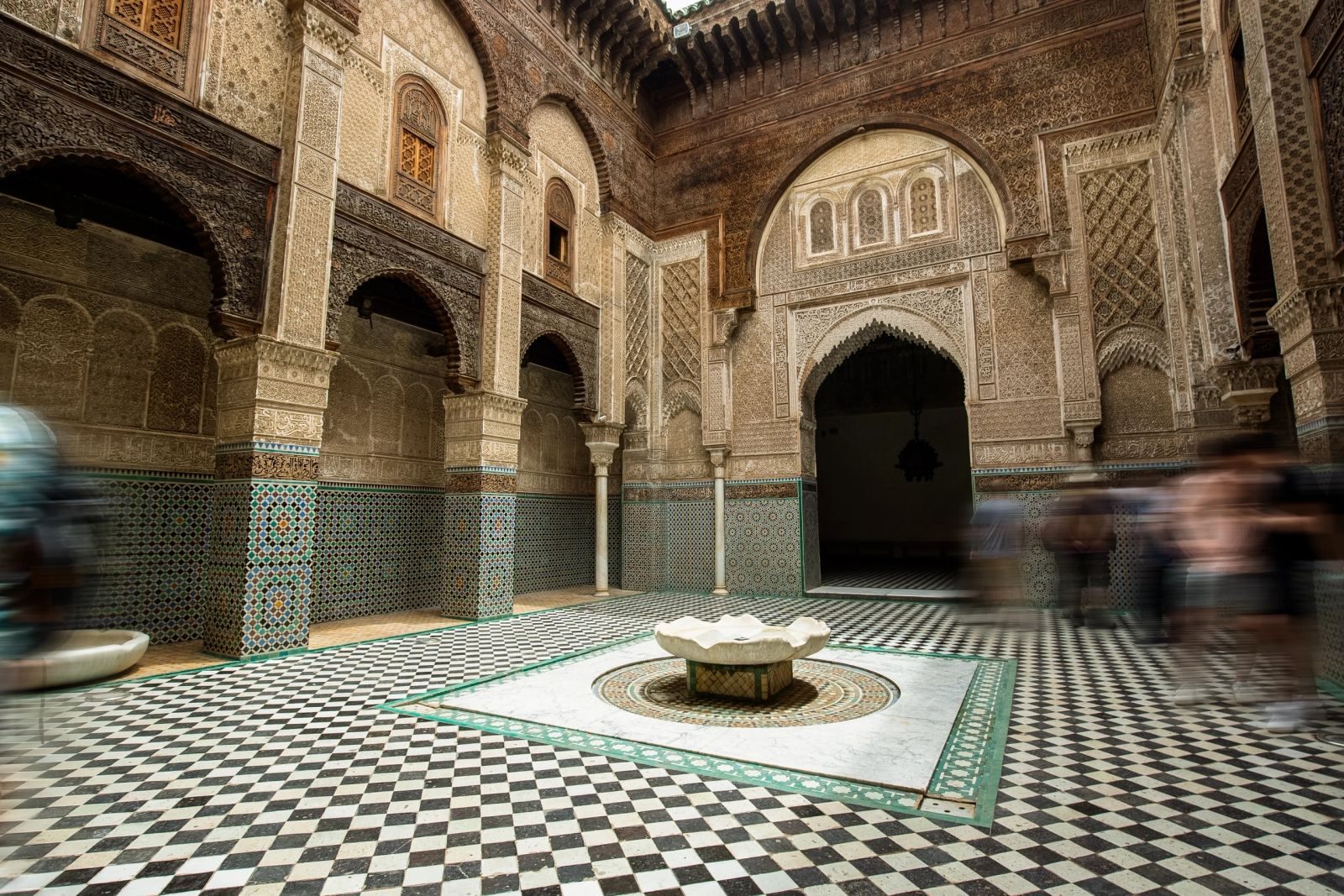
Upon reaching El Attarine, one encounters a small hallway and carved wooden doors. The warm light of the courtyard beyond glows invitingly. Historically, madrasas were spaces of learning and lodging where students studied Islamic sciences, mathematics, philosophy, and other subjects. Earlier Persian madrasas typically housed all four Sunni legal schools (madhabs). Moroccan madrasas, however, charted a different design path. Under Marinid Rule, medieval Moroccan madrasas housed only Maliki fiqh, with little to no competition from the three other legal schools (Hillenbrand, 7). Whereas previous Persian madrasas were segregated into multiple iwans for each madhab, Moroccan madrassas were built with a single congregational spaces. Such spatial concentration introduced remarkable clarity and cohesion in the architectural and spiritual narratives of Moroccan madrasas. This cohesion was both physical and metaphysical. Practically, the spaces functioned as social and pedagogical unifiers. Metaphysically, they symbolized God’s unity and oneness.
There was economic advantage to singular congregational spaces as well. El Attarine’s compact footprint and low material cost allowed the Marinids to leave a lasting architectural legacy despite relatively modest means. The resultant design was a somewhat simple, stripped-down courtyard typology, that was utterly invested in its spiritual charge rather than its architectural form. Marinid architects envisioned a design that bridged the seemingly insurmountable impasse between physics and metaphysics. El Attarine became a vessel through which the skies above touched the ground below. It was to be a meeting place between earth and the heavens, between the two seas.
The madrasa’s courtyard mediated between the realms, engulfing students and visitors in sacred rhythms of geometry, calligraphy, and vegetal motifs. El Attarine’s obsessive ornamentation was a portal through which its spiritual charge found expression. Furthermore, the ornamentation was not just a testament to technical and aesthetic mastery. It was a deliberate expression of divine unity. The madrasa’s surfaces were disclosures, not enclosures, reaching beyond their materiality and towards the unseen.
The Marinid’s meticulous craftsmanship embodied a metaphysical commitment to wahda (oneness) and kathra (multiplicity)1. For Ibn al-Arabi, the two—though seemingly opposed—are parts of a whole: God is one, while God’s manifestations are many. Chittick explains, although the One God in himself cannot be known, his manifestations cannot be avoided … knowledge of the One’s infinitely diverse manifestations is infinitely diverse, which is to say that God is known through takthir [or kathra] as well as tawhid [or wahda]” (Chittick, Science of the Cosmos 90).
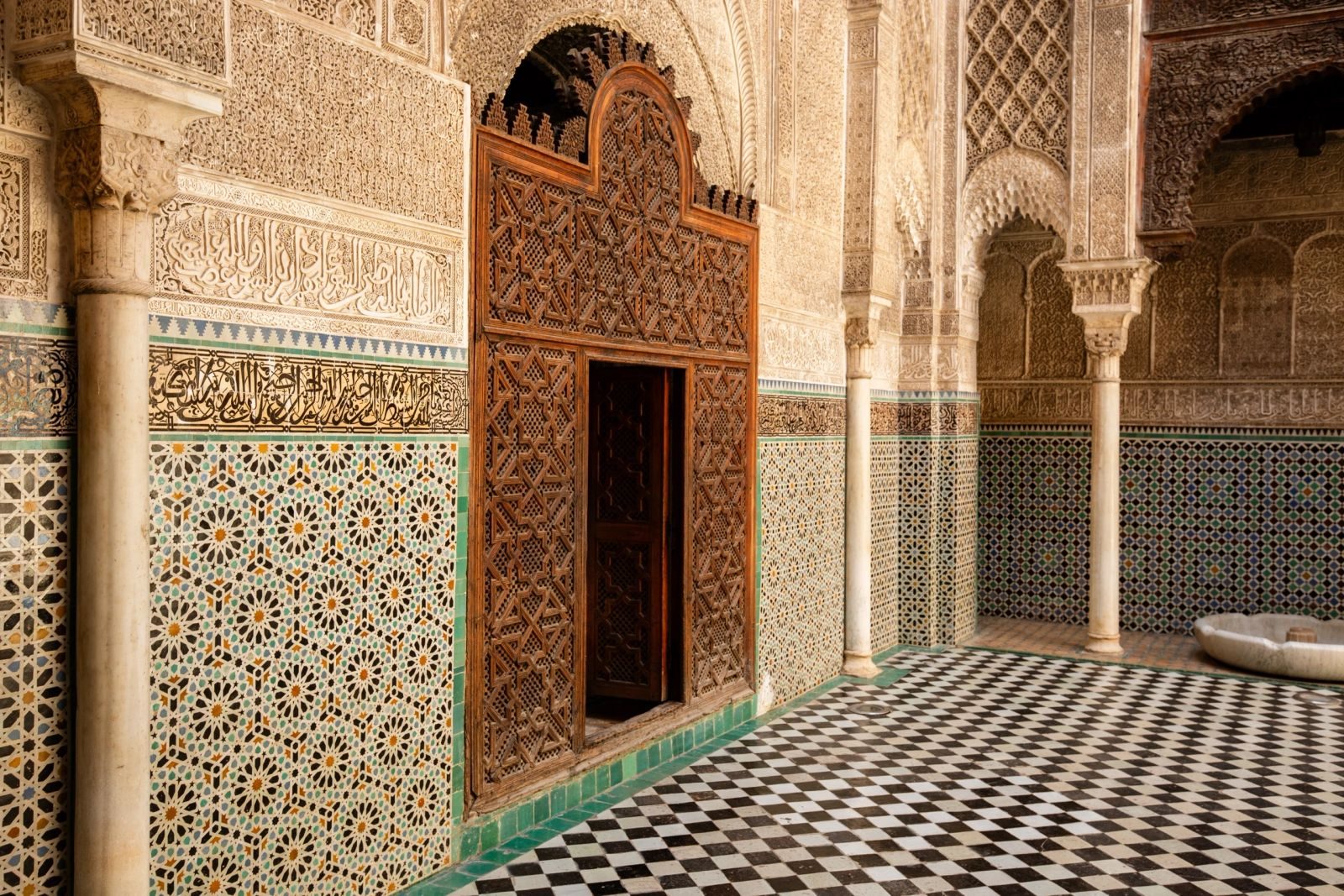
Marinid madrasa decorative ethos is based on an essential harmony. Being’s metaphysical wahda is revealed through worldly kathra of creation and existence. As Keith Critchlow notes, Islamic art “relates multiplicity to unity by means of mathematical forms which are seen, not as mental abstractions, but as reflections of the celestial archetypes within both the cosmos and the minds and souls of men [sic]” (Critchlow 6).
Contemporary architecture is overwhelmingly driven by capital and spectacle. Fes’s El Attarine is a reminder of something different. Architecture can be a cosmological act. Design can shape how we experience the cosmos and influence our ontic notions of Being. El Attarine is a threshold where sensory meets spiritual, clay meets Ruh, heaven meets earth. In El Attarine, our ontological predicament, between divinity and worldliness, finds alignment. El Attarine is a reminder that architecture is not just a backdrop, but a fundamental conduit for an entire barzakh cosmology.
1 Wahda refers to the ultimate oneness or unity of existence, while kathra refers to its infinite expressions.
Works Cited
Arberry, Arthur J., translator. The Koran. Reissue, Oxford University Press, 2008.
Bashier, Salman H. Ibn Al-Arabi’s Barzakh: The Concept of the Limit and the Relationship Between God and the World. State University of New York Press, 2004.
Burckhardt, Titus. Sacred Art in East and West: Its Principles and Methods. Translated by Lord Northbourne, 1st ed., Fons Vitae, 2001.
Chittick, William C. Science of the Cosmos: The Pertinence of Islamic Cosmology in the Modern World. Oneworld, 2007.
---. The Sufi Path of Knowledge: Ibn al-ʻArabi’s Metaphysics of Imagination. State University of New York Press, 1989.
Critchlow, Keith. Islamic Patterns: An Analytical and Cosmological Approach. Inner Traditions, 1999.
Hillenbrand, Robert. Islamic Architecture: Form, Function, and Meaning. Columbia University Press, 1994.
Damluji, Salma Samar, and John Hedgecoe. Zillij: The Art of Moroccan Ceramics. Garnet, 1992.