Essays61
“Our electric blankets and our chicken”
Daniel P Gibboney Jr
“Our electric blankets and our chicken”: The materialist cul-de-sac of (dis)comfort in My Dinner with Andre
With Muhammad, the supernatural element implied by Nature is not its inclusion of spiritual forces…but the fact that, while humans remain fundamentally dependent upon Nature, something outside of Nature- something supra-natural – consistently and deliberately decides what Nature shall or shall not produce: no blue roses, no immortal humans, no pinstripe skies.
- Sherman Jackson, The Islamic Secular (2024)
In an interview sometime after 1981, Andre Gregory was asked about whether he and Wallace Shawn would ever make a sequel to My Dinner with Andre (1981). After deflecting with a few half-sentences, Andre responds that if he lives to 85 and Wallace lives to 75, they might. In Digestifs with Wally (I’m making up a title), Andre suggests they could sit in rocking chairs and focus on the “one thing we don’t talk about at all (in My Dinner with Andre), sex.”1 This isn’t exactly true. In Andre’s defense, however, sex is given less airtime than hospital falls, New York parties, and a Buddhist monk at Christmas mass.
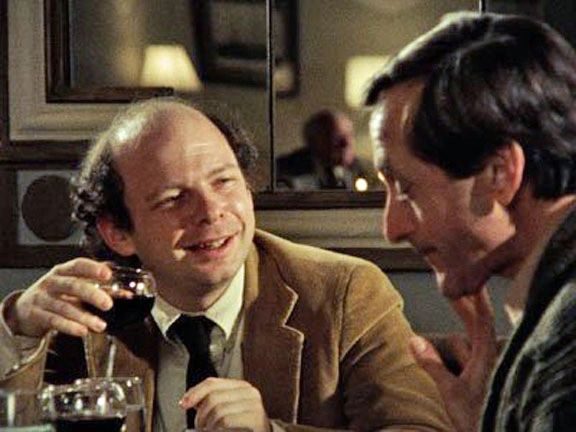
My Dinner with Andre is about an evening out. Wally and Andre, two theatrical acquaintances, share a mealtime conversation. Andre talks at length about Polish paratheatrics, Surrealist magazines, impromptu christenings, and eating sand. Wally mostly nods, occasionally interjecting “what do you mean exactly?” or “God! Well, tell me about it.” He wasn’t, after all, “sure (he) could stick through an entire meal with (Andre).”
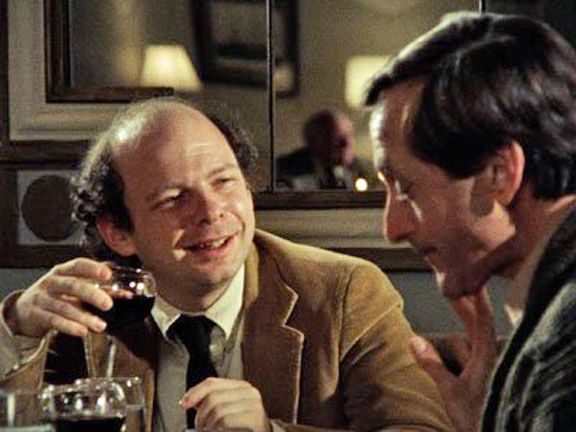
Wally also mentions his electric blanket. Speaking of this “marvelous abundance over (his) old way of life,” he wonders, “what is it doing to me? I mean I sort of feel I’m not sleeping quite in the same way.” Andre agrees, Wally’s slumber isn’t unchanged.
This consensus frays before it ever begins. Whereas Andre unequivocally “wouldn’t put an electric blanket on for anything,” Wally expresses an equal steel in another direction - he “wouldn’t give up (his) electric blanket…(life is) tough enough as it is, I’m not looking for way to get rid of the few things that provide relief and comfort…on the contrary.”
Andre finds Wally’s very solicitation of comfort “dangerous…we’re having a lovely time with our electric blankets and our chicken, and meanwhile we’re starving because we’re so cutoff from contact with reality that we’re not getting any real sustenance.” To Andre’s mind, technology is a rascal, a thief that robs human beings of the authenticity that discomfort provides – “we’re animals after all…instead of living under the sun and the moon and the sky and the stars we’re living in a fantasy world of our own making.”
After Andre rambles on a bit longer, Wally asks “d’you wanna know my actual response to all this? I mean, do you want to hear my actual response?” Expressing skepticism that “anybody could enjoy something more than…reading Charlton Heston’s autobiography…or (a) cup of cold coffee that’s been waiting (all night),” Wally dismisses “any kind of prophecy or sign or an omen…they don’t mean anything.” Instead of tradition, ritual, or religion, meaning, according to Wally, is found when a “group of meaningless facts…are collected and interpreted in a scientific way.” Science discovers order in the material universe; it is how human beings “at least know that the universe has some shape and order, and that…trees do not turn into people or goddesses.” Science also brought us the electric blanket.
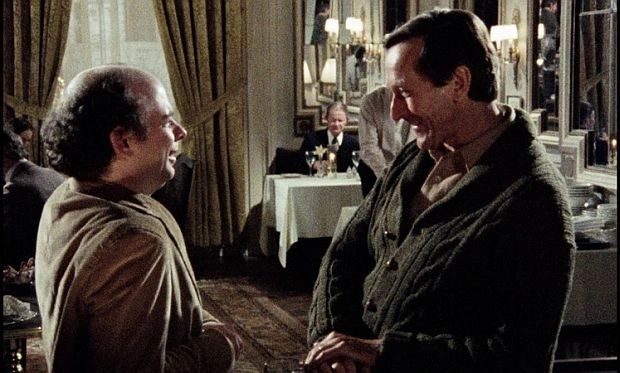
Andre, quite predictably, finds Wally’s faith in science a false flag. Rather than being “a magical force that somehow solves everything,” science spectacularly mucks things up. It neither discovers nor enriches. It deprives and scandalizes.
Andre offers human connection and intimacy as something to conversely strive for. Nonetheless, there’s a problem, because the closer you come…to another human being, the more completely mysterious and unreachable (they) become…And that’s to face -- to confront the fact that you’re completely alone, and to accept that you’re alone is to accept death…you know, in the sexual act there’s that moment of complete forgetting which is so incredible…that’s why I think people have affairs…to give you the semblance that there’s firm earth.
Neither Andre’s existentialism nor Wally’s science are predicated on anything but themselves – a self-referential loop of vulgar materialism. Neither men see nature nor human beings as pointing beyond itself. Sansany metaphysical commitment, both endorsed charters are presented means of fleeing death – Wally with his blanket and Andre by way of hypothetical progeny. Wally and Andre don’t actually disagree in any substantive sense. They both present a materialist cul-de-sac, either fetishizing or spurning discomfort.
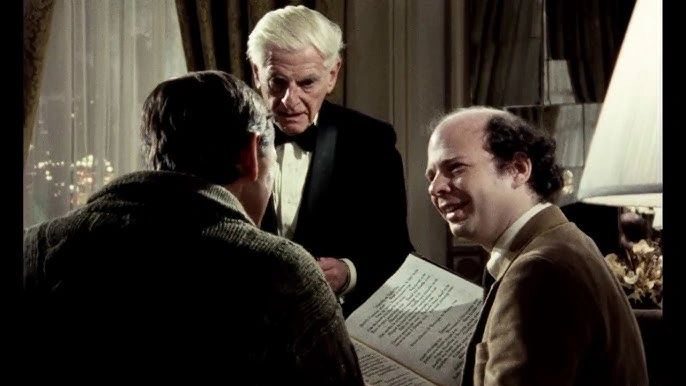
There is at least one thing Wally and Andre didn’t discuss. It’s not sex. They discuss death, but not an afterlife. They debate the nature of materiality, but not transcendence. Maybe the waiter believes in God. But he is only allowed to ask if Wally and Andre want anything else.
References
1 “My Dinner with Andre: Interview with Andre 3/3” Youtube, uploaded by K Jones 29, August, 2011, https://www.youtube.com/watch?v=WHhaPXU-C6g.
Daniel P Gibboney Jr lives in Houston. He holds an MA in Religion from the University of Chicago's Divinity School and a Ph.D. in Cultural Studies From the University of North Carolina at Chapel Hill's School of Education. He currently works and teaches at Rice University.