Essays26
Echoes of Modernity: Hotel du Lac and Postcolonial Tunisia
Amer Ayyash & Mario Wasef
فندق البحيرة: صدى الحداثة والهوية
Modernity promised progress through glass, concrete, and order. But in the hands of former colonies, it arrived as a borrowed language, articulated through foreign architects, alien materials, and imported ideals. The result is a city that looks forward but speaks with a voice it does not fully recognize as its own.
– Amer Ayyash
"Every city has its echo, which depends on the pattern and scale of its streets and the prevailing architectural styles and materials" (Pallasmaa, p. 51). Juhani Pallasmaa, expands on this idea, noting that the echo of a city—its spatial rhythm, material texture, and architectural tone—shifts across time and typology. Pallasma’s observation prompts us to ask a question: what becomes of colonized cities? Have their echoes been erased, altered, or reshaped by colonial powers? Moreover, how can a city, burdened by the legacy of colonization, break free from such a painful past, and what steps can be taken to reclaim and redefine its identity?
These questions are particularly relevant to the case of Tunis, the capital of Tunisia, following independence in 1956. This pivotal moment marked the beginning of a new era and a revolutionary transformation. Then-Prime Minister, later President, Habib Bourguiba sought to restore the city's echo by pursuing an agenda of modernization all the while distancing Tunis from the French-influenced culture, architecture, and traditions of the colonial period (Elshahed). Bourguiba’s vision aimed to redefine Tunis as a symbol of a distinct national identity, with architecture playing a central role in this cultural and political reformation.
Bourguiba focused on architecture and tourism as complementary strategies (Elshahed). He sought to introduce new architectural styles by inviting renowned international architects to design key buildings, creating a modern image for the nation. These initiatives were intended not only to reflect progress but also to attract tourists, positioning Tunisia as a dynamic and forward-looking destination. Through these efforts, Bourguiba aimed to craft a new identity for Tunis that would resonate both locally and globally.
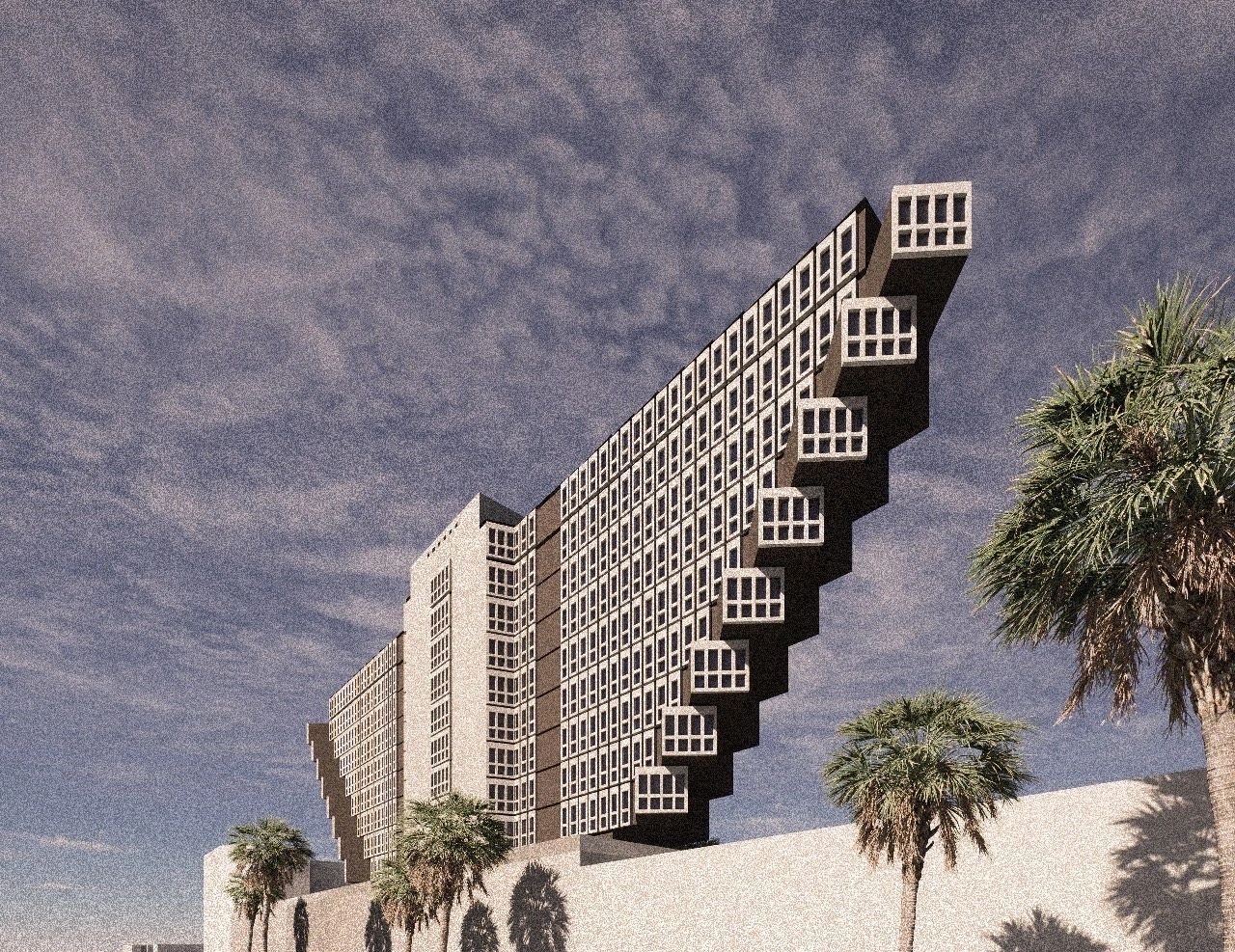
As part of this vision, Bourguiba aimed to introduce new ideas and styles into Tunisian architecture. The Hotel du Lac, designed by Italian Architect Raffaele Contigiani, stands as an architectural leap of this period (Elshahed). It was one of the few hotels specifically conceived to become a landmark, distinguished by its bold form and central location in the heart of Tunis.
However, this prompts us to ask: could the revival of traditional architectural styles, overshadowed during colonial rule, truly drive the nation forward? Or did such efforts risk drawing attention to a past marked by vulnerability and subjugation, at a time when the country was striving to establish its independence? Furthermore, entrusting European architects with such a critical role in the country's transformation raises the question of whether this decision hinders Tunisia's efforts to fully detach from its colonial past, or if it was an inevitable part of the process.
Before the Hotel du Lac’s 1970 construction , Tunisia faced major political, economic, and social challenges. Many of which stemmed from decades of French colonial rule (1881–1956). Tunisia’s mid-20th century independence marked a turning point, as the nation began pursuing self-determination and modernization (Clarke and Brown). Tunisia’s struggle for liberation was driven by widespread resistance to oppressive colonial policies, including the exploitation of land and deepening of social divisions. These impacts also affected Tunisia’s cultural identity and built environment. Prior to independence, the architectural landscape reflected colonial dominance, blending French design with traditional Tunisian motifs (Monks). Colonial architecture often featured ornate facades, grand public buildings, and monumental forms inspired by European urban aesthetics—intended to assert authority and create familiarity for settlers (Kenzari).
After independence, the Hotel du Lac became a unifying symbol for the Tunisian people and stood out for its forward-thinking design and architectural ambitions. Contigiani’s modernist approach had already begun to take shape in earlier projects, most notably the Italian Pavilion at the Zagreb Fair in 1956. There, he experimented with modern construction techniques and geometric forms, including the inverted pyramid—a motif that would later define the striking silhouette of the Hotel du Lac (Elshahed, 2017). The hotel’s high-rise residential typology, comprising 10 floors and 416 rooms, showcases an innovative approach to vertical space utilization (Monks). This is complemented by the building’s geometry, resembling an inverted pyramid, which gradually widens as one ascends each floor. Therefore, the width of the ground floor would be half of that of the topmost floor, maximizing room availability and providing captivating views for guests on the upper floors (Giuroiu). Additionally, cantilevered stairs extrude from each lateral end of the main elevation’s floors, not only accentuating the building’s stereotomic mass, but also serving as distinctive circulation elements viewed from the exterior (Hilburg). Despite their substantial appearance, these stairs appear angled and somewhat floating, creating a visual contrast from the exterior view.
Contigiani’s design for the Hotel du Lac, similar to Le Corbusier’s principles from the domino framework system, segregates vertical circulation and disengages structural columns from the building’s edge (McGuirk). This creates non-load-bearing external walls and enables an open-plan configuration. The flexibility achieved ultimately breaks the confines of the typical high-rise building, by allowing for more openings and providing occupants with unobstructed views of the surrounding landscape, all while maintaining the structural integrity of the building.
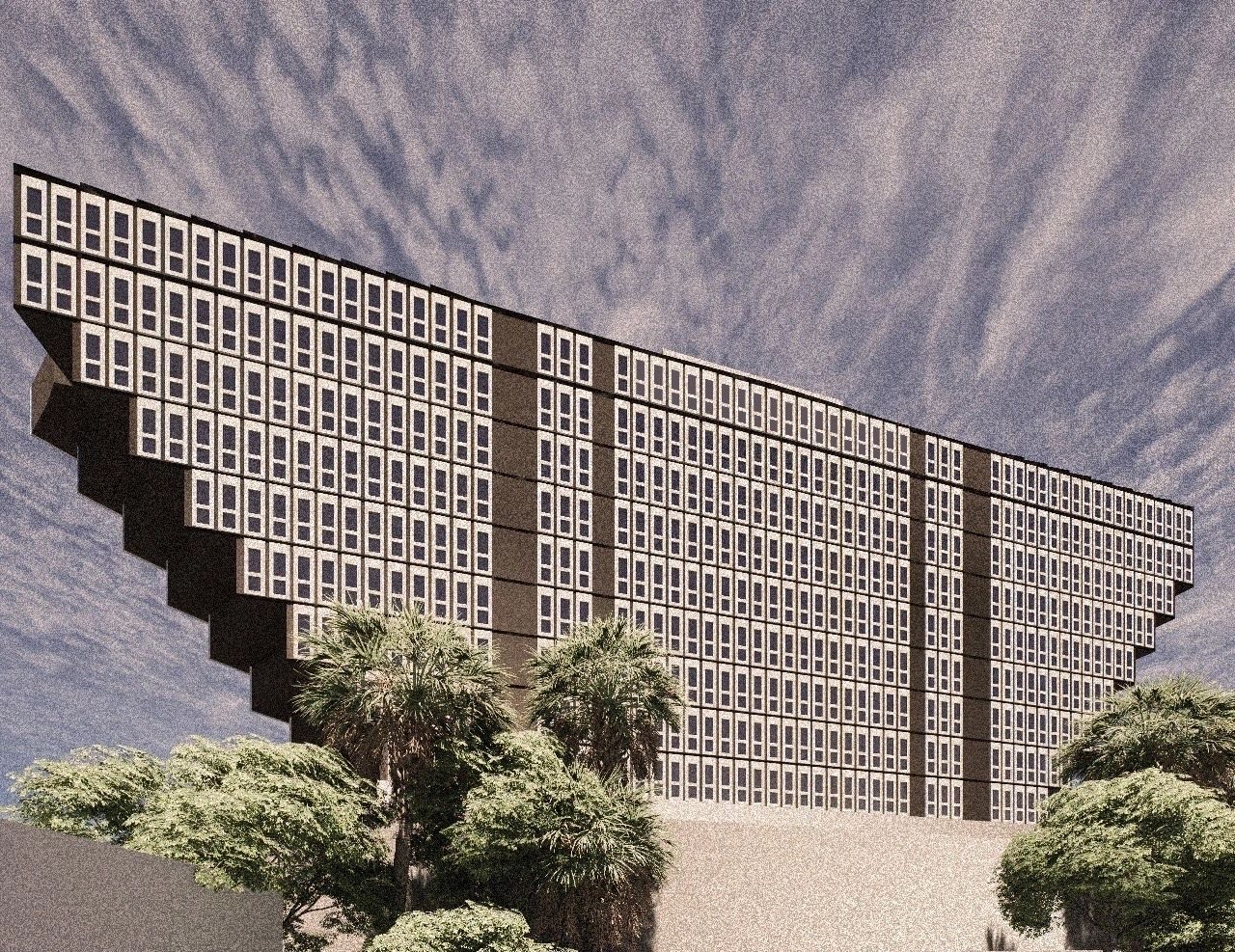
Despite its original envisioning as a symbol of progress, the Hotel du Lac’s fate did not unfold as the government anticipated. In the early 1980s, Tunisia faced economic challenges largely caused by government mismanagement, prompting efforts at economic revival in the 1990s. Ironically, efforts to attract foreign investment led to the hotel’s mismanagement by foreign ownership, ultimately resulting in permanent closure (Elshahed, 2017). Today, the building’s future remains uncertain, with ongoing ownership transfers and the threat of demolition signaling local unrest. Once a proud emblem of modernity, the Hotel du Lac now stands as a focal point for preservationists advocating for the protection of its architectural and cultural legacy (Hilburg, 2020).
This outcome reflects broader challenges within President Bourguiba’s modernization agenda, which subtly mirrored Le Corbusier’s urbanist framework for colonial Algiers. As Çelik observed, Le Corbusier’s plans for Algiers aimed to integrate diverse populations while maintaining a division between them, promoting local culture while accommodating European needs. Similarly, Bourguiba’s vision for Tunis, embodied by the Hotel du Lac, sought to project modernity on the global stage. However, what Bourguiba may not have fully anticipated when commissioning the project to the modernist architect Contigiani—seemingly influenced by Le Corbusier’s urbanist principles—was that the resulting design primarily catered to European tourism while excluding much of the local population, revealing a prioritization of external image over local inclusivity.
This reliance on European modernist principles following independence highlights Tunisia’s struggle to assert its own identity. While the project was intended to symbolize progress, it inadvertently reinforced divisions, reflecting Bourguiba’s focus on external recognition rather than national unity. Though perhaps unintentional, the hotel clearly catered to European tourists rather than local citizens, raising questions about how a European architect could authentically translate Tunisian architecture into a ‘modern’ form without imposing external values.
In the end, one is left to wonder: even if Bourguiba had commissioned a Tunisian architect, would they have truly been granted the power, autonomy, or resources to produce something as monumental as the Hotel du Lac? Or would their vision, inevitably, have been filtered through the same lens of imported modernist ideals, judged by standards shaped elsewhere? The irony deepens when one recalls Le Corbusier’s own proclamation that architecture must respond to culture—an ideal he rarely upheld in his own visions. The modernist pursuit, with all its ambitions of rational order and universal form, so often neglects the complex texture of lived reality. What, then, is modernity, if not a projection of desire—a constructed illusion of progress that promises inclusion but quietly excludes?
In searching for “modern identity,” states like Tunisia frequently found themselves detaching from their own histories, embracing an imported aesthetics while silencing nuances of local expression. This detachment reveals itself not only in form but in function. Buildings, like the Hotel du Lac, became monuments of aspiration rather than spaces of belonging. Perhaps the modern man—ever searching for clarity in a fractured world—must finally confront modernism’s failure to fulfill its own promises. And in that failure, maybe, lies the opportunity to imagine new forms grounded not in detachment, but in dignity.
Works Cited
Celik, Zeynep. “Le Corbusier, Orientalism, Colonialism.” Assemblage, vol. 17, no. 17, Apr.
1992, pp. 58–77, https://doi.org/10.2307/3171225.
Clarke, John, and L. Carl Brown. “Tunisia - the Protectorate (1881–1956).” Encyclopædia
Britannica, 2019, www.britannica.com/place/Tunisia/The-protectorate-1881-1956.
Elshahed, Mohamed. “Icon at Risk: Hotel Du Lac in Tunis.” Cairobserver.com, 2019,
cairobserver.com/post/161989122209/icon-at-risk-hotel-du-lac-in-tunis.
Giuroiu, Anton. “Hôtel Du Lac / Raffaele Contigiani | Classics on Architecture Lab -
ArchitectureLab.” Architecture Lab, 17 Aug. 2024,
www.architecturelab.net/hotel-du-lac-raffaele-contigiani/. Accessed 26 June 2025.
Hilburg, Jonathan. “Tunisia’s High-Flying Brutalist Hotel Is Safe after Demolition Scare.” The
Architect’s Newspaper, 13 Mar. 2019,
www.archpaper.com/2019/03/tunisias-high-flying-brutalist-hotel-demolition-scare/. Accessed 26 June 2025.
Kenzari, Bechir. “The Architects of the “Perchoir” and the Modernism of Postwar
Reconstruction in Tunisia.” Journal of Architectural Education (1984), vol. 59, no. 3, 2006, pp. 77–87. JSTOR, www.jstor.org/stable/40480648,
https://doi.org/10.2307/40480648.
McGuirk, Justin. ““The Perfect Architectural Symbol for an Era Obsessed with Customisation
and Participation.”” Dezeen, Dezeen, 20 Mar. 2014,
www.dezeen.com/2014/03/20/opinon-justin-mcguirk-le-corbusier-symbol-for-era-obsesse d-with-customisation/.
Monks, Kieron. “The Upside down Hotel Said to Have Inspired Star Wars Faces Demolition.”
CNN, 25 Mar. 2019, edition.cnn.com/style/article/hotel-du-lac-tunis/index.html. Accessed 26 June 2025.
Pallasmaa, Juhani. The Eyes of the Skin. Chichester Wiley, 1996.