Essays56
Coffee Conundrums: Prohibition and Revival in Early Modern Times
Hussein Bachacha
Coffee holds symbolical social meanings that are discerned in the Middle East according to the context in which it is consumed. The drink, for example, plays a part in vibrating the hospitality and generosity of the Arab household when served to guests or, in different instances, reflects a sense of sadness when served unsweetened and bitter to mourners at certain funerals.1 Such symbolism, among others, reflects the drink’s intimate integration into the region’s social psyche and its significance to be enjoyed with others. One wonders how this came to happen, as a steppingstone, we’ll discuss in this article coffee’s prohibition and its thriving in the early modern period, attempting, in turn, to scratch the surface of such a complex question.
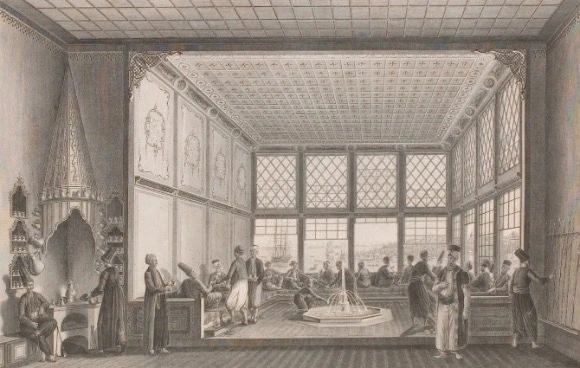
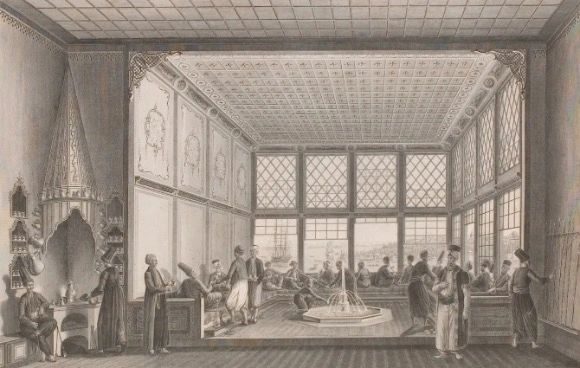
One can’t talk about the history of coffee without talking about the institution it inhabited. A proto-Muslim project, coffeehouses were key in the spreading story of the drink throughout the Ottoman Empire in the 16th century thanks to the unprecedented atmosphere they offered. Ironically, however, the institution exposed the drink in parallel to the heated opinions of frustrated scholars, leading to its prohibition and, in turn, the distortion of its once innocent image enjoyed when it was initially, according to the sources, consumed and introduced by Sufis from the Yemen.2 We’ll mention briefly why this came to happen and how the drink thrived regardless.
The least problematic aspect of coffeehouses was the waste of time, owed to the populace abusing the place by lingering there over small conversations, backbiting, and puppet shows. The 17th-century Ottoman traveler Evliya Çelebi (d. 1682), for example, explicitly mentions his unprecedented exposure to such pastime activities in coffeehouses, especially during the night which he apparently didn’t mind enjoying.3 The institution proved itself a novel venue for the people to meet instead of mosques and shops, exposing it and the drink it served consequently to the prejudice of watchful antagonists. On a higher note, drug usage was another controversial aspect that gradually became associated with the place and, therefore, the drink itself. Kâtip Çelebi (d. 1657), the Ottoman intellectual and geographer, reflects for instance in his famous treatise called The Balance of Truth (Mizanu’l-hak fī ikhtiārī al-ahaqq) where he mentions, along with other comments, how drug addicts were drawn to the drink “willing to die for a cup.”4
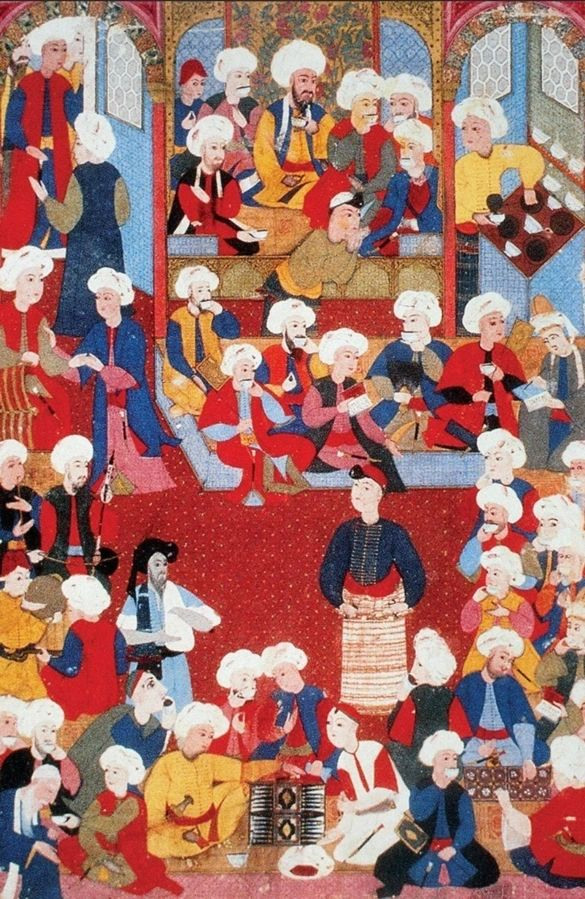
Provocative activities, finally, such as gambling, same-sex flirting (usually with the boys serving the coffee), and shows of dancers held for visitors, were frequently held and allowed in coffeehouses, resulting in, obviously, enraged muftīs who passionately issued fatāwas attacking both the establishment and the drink it served. All of the above factors, among others (of social, political, and even medical nature), were met in consequence with long campaigns of opposition, culminating in coffeehouse bannings recurrent up until the modern period.
Now, how coffee resisted these long campaigns is a complex discussion, as complex as the long prohibitory discourses we superficially approached. On a macro-economic level, the coffee trade proved itself highly profitable to merchants, even the state, at a time when the empire faced dire economic challenges following the Portuguese success in the Indian Ocean and the discovery of the new world.5 On a more personal-social level, the public, unwilling to revert to their traditional forms of leisure (which lacked the lively ambiance of coffeehouses), played a central role in resisting the opposition. Coffee’s intrinsic differentiator – its grip on people’s daily routines and its tendency to make its drinkers accustomed to it quickly – made its integration process easier and its vindication prevalent. Coffee’s transformative impact on the concept of nighttime, subsequently, was a significant reason for many to stand in support, with unexpected important figures like Koca Sinan Paşa, a grand vizier who frequently accredited coffee for its role in keeping him up at night to vigilantly oversee his state work.6
Coffee was too revolutionary of a product to bring down. Its success can be explained through countless readings from the sources available; some historians even attributed it to the general changing patterns of luxury consumption around the world in the early modern period.7 The past aside, however, we sure are glad that coffee made it through the struggle in the end. Regardless of its positive social, economic, and cultural impacts on the world’s history, the drink does certainly make our peaceful mornings all the more enjoyable.
Works Cited
1 “Palestinian Social Customs and Traditions”, Institute for Middle East Understanding, Accessed December 12, 2023. https://imeu.org/article/social-customs-and-traditions
2 For more information check Ralph S. Hattox’s Coffee and Coffeehouses : The Origins of a Social Beverage in the Medieval near East.
3 Kafadar, How Dark is the History of the Night, 249.
4 Haji Khalifeh, and Geoffrey L Lewis, The Balance of Truth, 60.
5 Faroqhi, Coffee and Spices, 91-93.
6 Kafadar, How Dark is the History of the Night, 254-255. Also, the grand vizier, using the excuse of the people needing a place to enjoy their downtime, projects his stance further with his subtle defense of coffeehouses the Sultan ordered to ban, 252.
7 Karababa and Ger, Early Modern Ottoman Coffeehouse Culture, 742-745.