Essays41
From Jalal to Infinity: Hazarat Sabir Piya’s Sufi Magical Realism
Maryam Shakeel
A thinly veiled distinction marks the separation between magical realism and Sufism, as the themes emerging from them are intricately woven into each other. Magical realism formally commenced as a literary movement in Latin America, produced outstanding contributions to literature through writers like Carpentier, Borges, Masood, and Marquez. This movement is deeply rooted in an individual understanding of reality and magic. Sufism, similarly, elevates the human approach to reality, urging a search beyond the apparent.
Within this context, I intend to explore the case of Hazarat Sabir Piya Kalyari, a renowned Sufi mystic of the Chishti tradition in South Asia, whose life embodies major themes of magical realism. Specifically, the fundamental role of fire, commonly understood as jalal (wrath), and the concept of fana vs baqaa (self-annihilation and subsistent permanence) demarcates the association between nature and man alongside the concept of infinity. By demystification of such diffused themes embedded in magical realism and Sufism one can gain significant insights into the common grounds shared by these realms.
It is often argued that narrative significance is crucial to magical realism, making it a stylistic approach shaped by the writer’s perspective on reality (Rajabi, Azizi, and Akbari 2020). Magical realism attempts to redraw the borders between magic and reality tending to establish foregrounds for the imagination to play. According to Rajabi, Azizi, and Akbari (2020), magical realism allows for an unreal phenomenon to occur within the context of reality, neither fully belonging to reality nor imagination, but functioning as an independent element.
A notable instance is narrated in Haqeeqat-e-Gulzar-e-Sabri, where Hazarat Ali Ahmed Sabir Piya was prophesied to his mother in dreams before his birth by several Sufi saints and the Holy Prophet (SAW) himself. According to this account, at the time of his birth, the nurse experienced a burning sensation upon touching him. Consequently, his mother instructed her not to touch him without ablution. When the nurse followed this instruction, she did not feel any burns while holding him. This incident is a key event in Haqeeqat-e-Gulzar-e-Sabri, the most renowned and authentic book of the Chishti tradition, particularly the Sabria branch.
The intensity of the jalal (wrath) is further illustrated by the narrative: as his mother held him after the bath, a sharp red light emerged from the sky, engulfing the house, causing the roof to collapse, and leaving the city of Herat fragrant with a divine scent for days. A critical approach to these events might comment on the amorphous nature of the narratives, questioning the truth or reality based on the arbitrariness of the witnesses' experiences. However, in this context, the mystical and magical converge, rendering the need for distinction or theorization unnecessary.
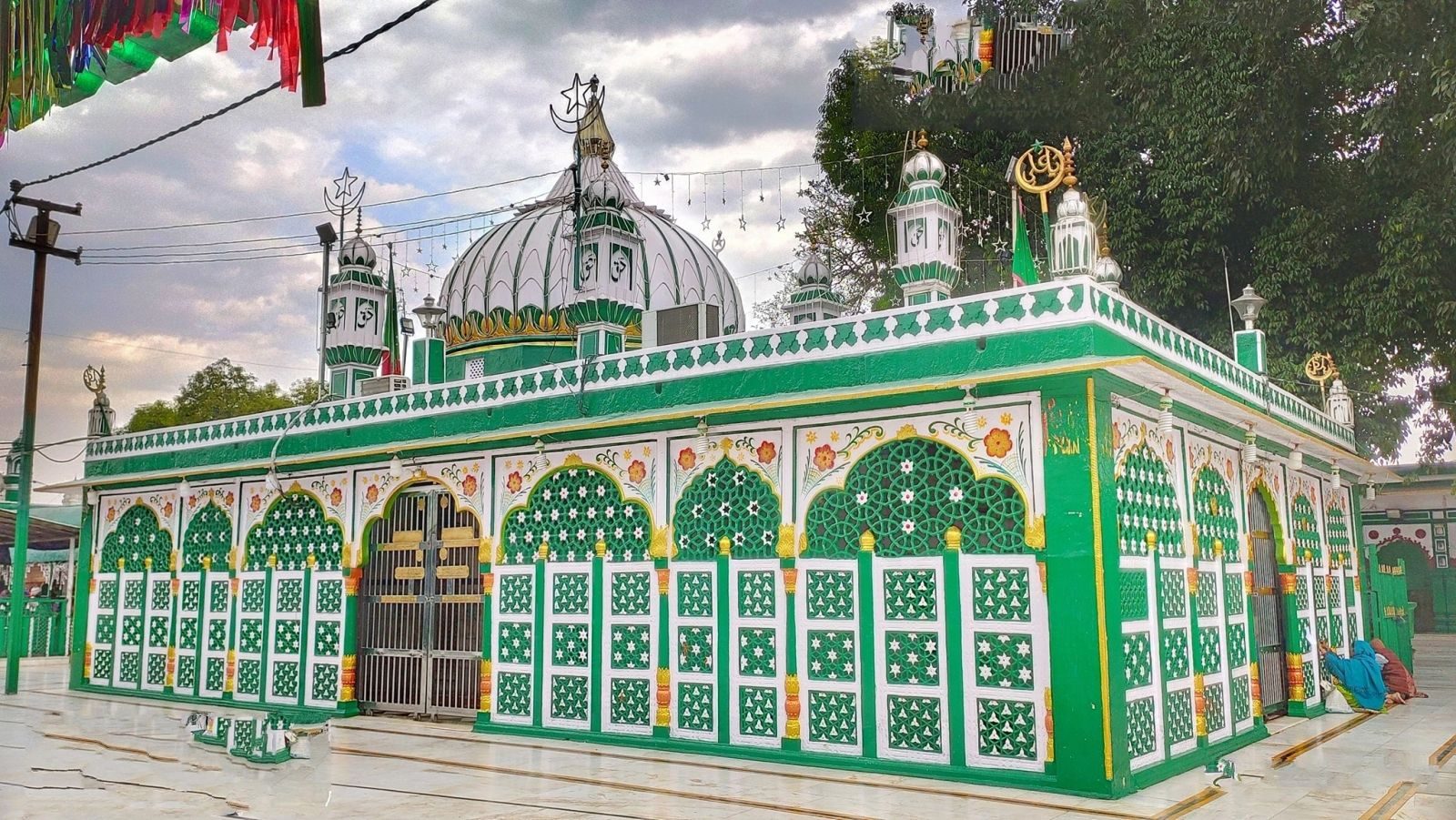
After being trained and guided by his predecessor, the immensely celebrated Baba Fariduddin Ganjshakar, Hazarat Sabir Piya was appointed to Kaliyar in India where he would continue his service as the saint of the area to guide people. Reportedly, despite several warnings of dire consequences, the rulers of Kaliyar refused to heed his message. When the Qazi of Kaliyar continuously disrespected him, Hazarat Sabir Piya entered a state of jalal (wrath) and commanded the grand mosque, filled with rebels, to bow in ruku (bow/submission), engulfing all those who were praying at the time. Following this event, he initiated the deconstruction of Kaliyar by standing beneath a Gular tree and reciting a few Quranic verses. Moments later, fire descended from the sky, engulfing the city in flames, yet leaving the houses of his followers untouched, along with the very spot where he stood, motionless like a statue. The fire lived robustly for the following four days and burned the city down to ashes meanwhile Hazarat Sabir Piya remained unmoved in the state of sukr (spiritual intoxication).
Additionally, the narration holds that Hazarat Sabir Piya predicted his death and instructed his followers not to perform any rituals. After he passed away, the patrons awaited his funeral arrangements until a veiled man on a horse appeared and performed all the rituals and the burial. Upon inquiry, the man revealed himself to be none other than Hazarat Sabir Piya, who then announced, 'The funeral service of this Faqeer has been conducted by the Faqeer himself,' thus demonstrating the concepts of fanaa (self-annihilation) and baqaa (subsistent permanence).
Ülgezer (2010) notes that the Sufi experience with a text is uniquely distinct from other approaches to textual engagement. This connection between magical realism and Sufism emphasizes individual narratives and interpretative variance, revealing that, despite language differences, the themes in Hazarat Sabir Piya's life and Borges' short story are deeply intertwined.
Magical realist authors aim to convey specific circumstances within their narratives and to impart the intended sense, they employ various tools, including religious iconography, allusion, and language. The use of religious language, in particular, allows them to infuse a sense of mystery and wonder into the narrative, something that scientific and rational language cannot achieve (Duncan). Simply stated, the genres of magical realism and Sufism can blend fiction, fascination, and reality in a harmonious way.
Taking a more straightforward approach, Borges' story The Circular Ruins will serve as a key reference here. I will use it to draw connections between Hazarat Sabir Piya's mystical experiences and the themes of magical realism. In Borges's The Circular Ruins, a man dreams of creating a perfect human, only to realize that his creation is dreaming of him. The story is impregnated with themes of reality, creation, and the cyclical nature of existence, with its focus on dreams, visions, and infinity offering valuable parallels for this exploration. Hazarat Sabir Piya’s existence was foretold in dreams even before his birth. Narrations suggest that his arrival was prophesied by Bibi Fatima, who told Bibi Hajra in a dream that she would bear a son to honor the martyred Imams of Karbala. Borges’ mention of a "former life" in The Circular Ruins echoes this idea, reflecting the boundless nature of both imagination and reality.
Secondly, Borges discusses the interconnectedness of magic, anatomy, and cosmography, examining the outcomes of their fluid nature and their impact on the universe. Sabir Piya’s control over fire, as an expression of his jalal (wrath), and his ability to wield it without exposing his fragile humanity, creates a seamless blend of reality and magic inherent in Sufism. Imagination plays a crucial role, as Sabir Piya never loses control of his power, ensuring it remains within the bounds of humanity.
Circularity and infinity are, arguably, some of the most peculiar yet inevitable themes in this story. The idea of existing in a dream before birth, the fulfillment of prophecies, life from birth to death, and Hazarat Sabir Piya's burial can be aligned with Borges' experiment, where his protagonist becomes an object of infinity. This unique paradigm suggests that Sabir Piya’s return to conduct his own funeral signifies the permeation of circularity in reality—expanding, contracting, moving fearlessly, and engulfing every moment into nothingness and back into something. The concept of circumambulation finds relevance in Sufism, reinforcing the magical realist intention of affirming human agency over forces of nature and supernatural powers.
The intersection of dreams and reality is vividly expressed in the case of Hazarat Sabir Piya. The idea of pre-history, a common theme in magical realist texts, also plays a significant role in the life of Hazarat Sabir Piya, reflecting the existence of truth in infinite forms. Research has shown that magical realism often intersects with myth and faith, as evidenced by the use of religious language by magical realist writers. The symmetry between Sufi texts and magical realist texts creates a shared understanding in their interpretations, making it difficult to categorize them as separate. Thematically, infinity emerges as the most plausible reality, encapsulating all truth. Recognizing Hazarat Sabir Piya, a great Sufi, as an embodiment of the themes and ideas found in magical realism, it becomes evident that art and humanity exist in a vivid correlation to circularity, with no defined beginning or end.
Works Cited
Borges, Jorge Luis. The Circular Ruins. Sur, 1940.
Chishti and Chishti. 1982. Haqeeqat-e-Gulzar-e-Sabri.
Duncan, Laura. 2015. “Believe in these things”: magical realism’s postmodern use of religious language. UTC Scholar (1. January). https://scholar.utc.edu/cgi/viewcontent.cgi?article=1306&context=theses.
Rajabi, Ayyub, Majid Azizi and Mehrdad Akbari. 2020. Magical realism: The magic of realism. Rupkatha Journal on Interdisciplinary Studies in Humanities 12, Nr. 2 (3. May). doi:10.21659/rupkatha.v12n2.18, https://doi.org/10.21659/rupkatha.v12n2.18.
Ülgezer. 2010. The Transformative Power of Text: The Case of the Sufi Poetic. MA Thesis, RMIT University. https://core.ac.uk/download/pdf/18619578.pdf.
Maryam Shakeel is a writer, researcher, and an obsessive enthusiast of literature, film, art, and theatre. Her passion for writing is driven by rage because once a teacher told her, “You cannot write, so better leave it”. She is a published author in several magazines including Dawn. Her work focuses on amplifying marginalized voices. Maryam's creative and critical approach to storytelling bridges cultures and ideas, driven by a passion for research and faith in the transformative power of stories.