Essays50
Mortality's Labyrinth: A Philosophical Odyssey into Death's Abyss
Sualiha Khan
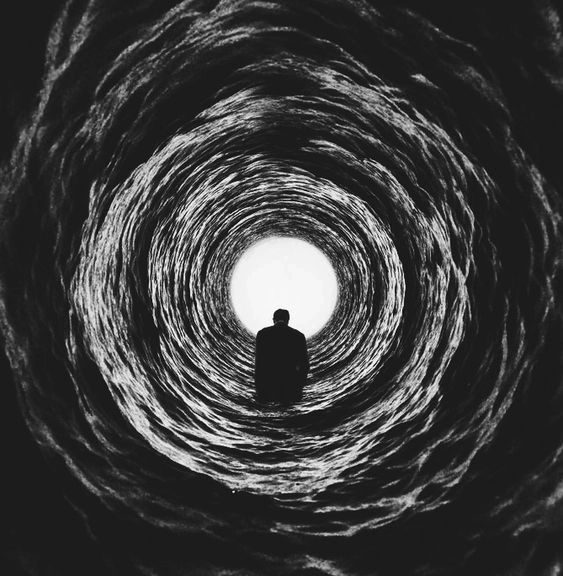
In the labyrinthine corridors of philosophical discourse, the phantom of death has perennially haunted the intellectual imagination, a subject of timeless inquiry. Embarking on this philosophical journey, we are confronted with the works of the philosopher Ernest Becker, whose works compose a waltz between humanity's denial of death and the paradoxical birth of beauty and tragedy.
Becker's philosophy is of the human impulse of "the denial of death." He argues that human beings form cultures, identities, and ideologies as a lap of belonging that comforts us from the gnawing realization of mortality. We toil for significance, for the creation of our own indelible 'marks' in a vast and alien world, creating, in the process, a paradoxically finite immortality, through artistic expression, scientific inquiry, or religious devotion. This existential strategy is, in essence, a defiance of death, a quest to transcend the finitude that engulfs us. This sentiment also echoes Milan Kundera's idea that all humans essentially want is to be "looked at" and that we want the eyes of spectators to solidify our fleeting existence.
In Becker's existential odyssey, the quest for symbolic immortality surpasses mere self-preservation; it serves as the cradle of creativity and beauty. It is our awareness of the chasm of mortality that carries us through the labyrinth of conscience and self-awareness-- a vein in our hearts that originates in the beauty of the terribly transient, in the hollowness of the present moment. In the shadow of impending death, we find the orchestra that dictates the harmony of meaning in our lives.
Death is a confrontation between mortality and immortality-- a hymn of our decay and an ode to the interconnectedness of the cosmos. In the grand cosmic narrative, we are but transient manifestations of celestial forces. Death, then, is not an annihilation but a homecoming to the cosmic source, a return to the primordial unity.
As Homer says, "The gods envy us. They envy us because we're mortal, because any moment may be our last. Everything is more beautiful because we are doomed. You will never be lovelier than you are now." There is a bittersweet beauty in the tragedy of the human tale; I guess humans like to watch a little destruction. And just as a finite canvas acquires value for its boundedness, our lives derive meaning from their temporality. Our mortality compels us to relish the present, to cherish the profound depths and layers of our relationships, and to savour the taste of the unsaid undone on our tongues.
In sum, the contemplation of death, in accordance with Ernest Becker's profound insights, beckons us to undertake a profound philosophical voyage into the depths of our existence. The universal dread of death, far from being a mere existential predicament, is a wellspring of philosophical profundity, offering us a lens through which to discern the purpose and value of our existence. By acknowledging the finite nature of life, we venture into the abyss, finding in its depths the essence of our philosophical quest for meaning.
Sualiha Khan is a student from Kashmir. Her primary interest lies in creative expression that blends philosophy, psychology, and fiction. Meaning and Conflict are her main domains of study.