Essays46
Picasso’s Calligraphic Alchemy: Merging Masteries
Ayah Issa
"If I had known there was such a thing as Islamic Calligraphy, I would never have started to paint. I have strived to reach the highest levels of artistic mastery, but I found that Islamic Calligraphy was there ages before I was."
This is what the renowned Spanish painter, Pablo Picasso said regarding Islamic Calligraphy.
Simply put, calligraphy is defined as “beautiful writing”. Islamic calligraphy is an expression of faith through an aesthetic linguistic representation. Islamic calligraphy does not exist within a uniform style. Islamic calligraphy forms are extensive, such as Kufic, Muhaqqaq, Naskh, Tawqi, Riqa, Shikasta, Thulth, and many other styles.
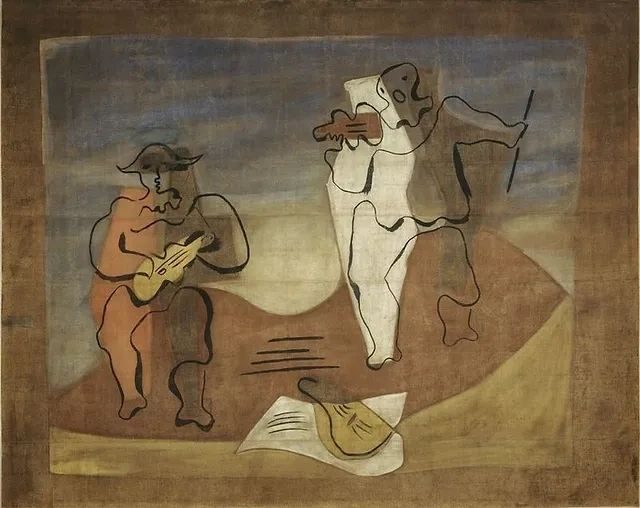
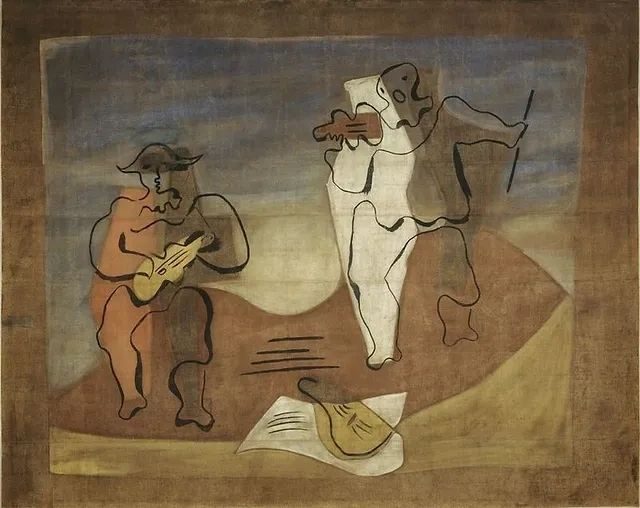
"[Picasso’s designs for the ballet Mercure] were written, so simply written, no painting, pure calligraphy", said Gertrude Stein (Picasso). In 1938, Gertrude Stein publishedPicasso, a book centered on her longtime friend and modernist artist, Pablo Picasso. In Picasso, Stein is completely in awe of Picasso. Stein spends the latter half of Picasso both describing and praising Pablo Picasso’s interest in calligraphy, specifically, “ Saracen1 calligraphy” (Picasso 33). Before Mercure, not many others realized Picasso’s affinity with calligraphy, having been branded as an innovative genius in the creation of cubism. It was in his work on the ballet, Mercure, that Picasso achieved recognition for his calligraphic practices. In fact, it was Picasso himself who said he would have chosen calligraphy before painting had he known about it years ago (Frembgen). This affinity towards calligraphy was not separate from his work in cubism; instead, as Stein says, “they [calligraphic drawings] were really cubism” (Picasso 38). Essentially, Picasso molded two customarily distinct artistic styles and, once again, created something new. Stein argues that Picasso’s identity as a Spaniard allowed him to apply Islamic calligraphy to his art without becoming a part of it or losing any part of himself.
Interestingly, many readers and viewers of Islamic calligraphy can simply see the art with or without the ability to understand the words and not lose the significance of the message. In this, the words become less like symbols that reference a real-world object, but actual pieces a part of an image. Jila Peacock, a calligraffiti2 artist, says, “... the word became the image” (Stoughton). In this case, the words function less as an element of writing and more as an element of art. This identity of a word is true for both traditional and contemporary Islamic calligraphy. I shall argue, using Bill Brown’s “Thing Theory,” that when an object is no longer doing what it is supposed to do, it loses its ability to be an object. Therefore, according to Brown, the object becomes a thing, in which a thing is an abstract, not completely accurate, or working form of the object.
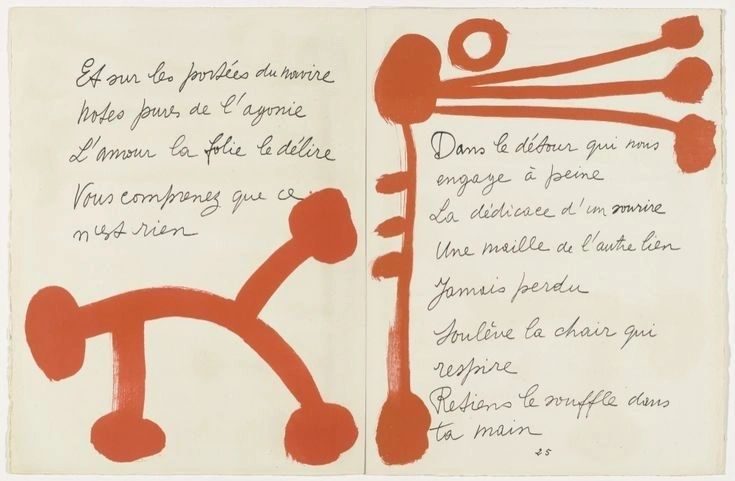
It was Stein who recognized Picasso’s ability to pull and manipulate from unlikely sources in order to influence originality within his own work. She argues that this is precisely what he does with calligraphy, Picasso was able to bring forth an aesthetic tradition of over a thousand years and hundreds of master calligraphers3 and make it undoubtedly new. While Stein most focused on Picasso’s engagement with calligraphy in his works surrounding 1913 to 1917 and the 1924’s Mercure, it is in Picasso’s collaboration with Pierre Reverdy in his book Les Chant Des Morts (The Song of the Dead) that, “the birth of calligraphy [became] the joining of two discrete modes of the mark” (Small 166). In the piece above, Picasso’s red marks are complementary to Reverdy’s writing. The red-painted lines, connected to filled and unfilled, red-painted circles, represent more than art to support the aesthetic of Reverdy’s book, but I believe represent a mixture of meaning between the red marks and black writing in order to simulate a function neither art nor writing alone can accomplish alone. The words and paintings compile their functions into one, similar to that of the words in Islamic calligraphy. In its natural form, Islamic calligraphy represents an artistic representation of faith, where the words serve as physical pieces of an image without forming a concrete image or icon. In Les Chant Des Morts, Picasso, with each page of poetry and red marks, creates his own representation of things as to how he imagines them rather than how he physically sees them (“Surrealism”).
1 The term “Saracen” is a medieval word for Muslims that has traveled into modern times. While the term refers to the religion, “Saracen” has been very commonly used to refer to both Arabs and Muslims. Although the two populations are distinct, the conflation arises as a result of much historical and stereotypical information. For example, as Arabic is the language of the Quran, it is common to connect language to geography and culture.
2 A form of contemporary Islamic calligraphy
3 Master calligraphers are professionally trained for years and must create a piece at the end of their training to be judged by a panel of master calligraphers. If approved, the student is granted their license, ijaza, in calligraphy.
Works Cited
Frembgen, Jürgen Wasim. The Aura of Alif: the Art of Writing in Islam. Prestel, 2010.
Small, Irene. “Letters of Mourning.” Picasso and the Allure of Language, by Mary Ann Caws et al., Yale University Press, 2009, pp. 162–167
Stein, Gertrude. Picasso. Charles Scribner's Sons, LTD, London and Beccles, 1939.
Stoughton, India. “Calligraffiti.” 1843, The Economist, 22 May 2017, www.1843magazine.com/features/calligraffiti