Essays44
Where is God in the Silence?


Yara Ammar
“Meanwhile, where is God?.. Go to Him when your need is desperate, when all other help is vain, and what do you find? A door slammed in your face, and a sound of bolting and double bolting on the inside. After that, silence. You may as well turn away. The longer you wait, the more emphatic the silence will become. The conclusion I dread is not ‘So there’s no God after all,’ but ‘So this is what God’s really like.” C.S. Lewis.
A big void and you’re left on your own. You continuously pray and plead but are only left with your own voice. With every prayer a renewal of hope for it to be a different outcome, yet nothing, but silence. Silence is like “a cancer grows” (Simon 1964). Eventually, you’re either left with silencing your voice and falling into despair or changing your view of God. Many people are familiar with this experience and it’s only then natural to wonder and question where is God? And why does he sometimes seem absent?
Muslim philosophers and scholars of the past would have found the notion of God’s silence absurd because to them it was a given that speech is a fundamental aspect of divine manifestation (Chittick 2020). God’s speech is everywhere at all times. They considered the universe to be God’s speech. How then can we often not hear? William Chittick offers an answer that maybe it’s our inability to hear and our readiness to receive that determine our experience of God. “Each individual human is a unique pot, receptive toward the ocean in its own measure” (Chittick 2020). The notion of “people hearing without listening” (Simon 1964) or how it’s described in the Quran “they have ears but they do not hear with them” (7:179) suggests that it is our capacity for listening that results in our perception of God’s absence. If our subjective states determine our experience of God, then we cannot dismiss psychology from our analysis.
Do our psychological states impact our capacity to listen? According to the Polyvagal Theory, they do. The Polyvagal Theory, as outlined by, Steven Porges states that the human nervous system alternates between three states. Although this theory is controversial for various reasons, it could help explain why people experience alternations in their connection to God. When a person feels happy, joyful, and alive, they will naturally feel more connected to God as their nervous system is in the ‘ventral vagal state’. In this state, the nervous system is more receptive and open. The ‘sympathetic’, or the fight or flight state, occurs when the person is stressed or anxious from a perceived threat. When the nervous system moves into that state, it perceives the world differently from the ‘ventral vagal state’. In the ‘sympathetic state’, the person becomes more vigilant and cautious, and the body’s organs work harder because they are in a state of preparation. People with trauma in particular are very prone to experiencing this state. The third state in the Polyvagal Theory is known as the ‘dorsal vagal state’. It’s a state of shutdown, disconnection, depression, and overwhelm. In this state a person would feel disconnected from the self, others, and ultimately from God.
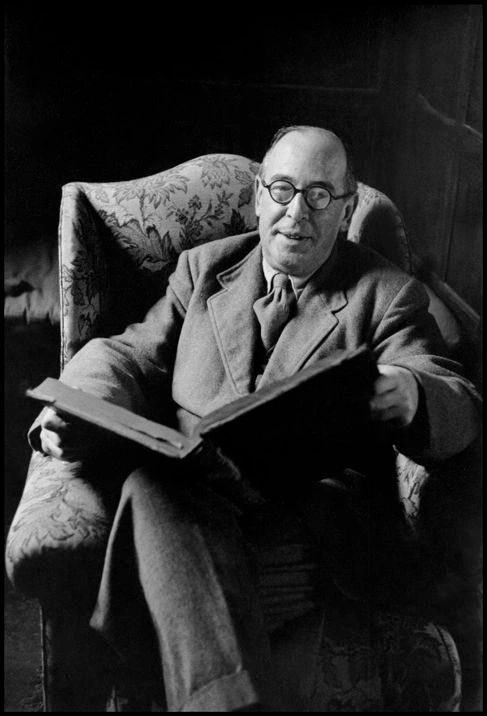
Let’s take the case of C.S. Lewis as an example. Lewis experienced the severe trauma of losing his wife, in light of which he wrote the aforementioned passage. Effectively, he was in the ‘dorsal vagal state’, unable to experience a sense of Divine presence. These states can last from a few minutes to years. According to that theory, C.S. Lewis was probably neurologically and psychologically unable to listen due to the state of his nervous system. That leaves us humans with a paradox: how can we try to ‘listen’ if sometimes our nervous system won’t even allow it? As mentioned earlier, the nervous system moves through these states. They are not permanent and the transition between them could take only a few minutes. Assuming C.S. Lewis was in the ‘dorsal vagal state’, it doesn’t mean he can’t go up the ladder to the ‘ventral vagal state’ even if for a few minutes.
In an interview with psychologist Heidi Burmeister-Nel, she says that the way God is perceived is from these states of the nervous system. She mentions how humans are turbulent with thoughts, emotions, and experiences, which affects and clouds how they see and experience God. Nevertheless, God is constant. Martin Buber eloquently encapsulates the aforementioned perspectives in this quote: “Whoever knows God also knows God’s remoteness and the agony of drought upon a frightened heart, but not the loss of presence. Only we are not always there” (Buber 1970, p. 147). The Polyvagal Theory, in harmony with William Chittick’s discussion of receptivity, roots the problem of our painful experience of Divine absence in our subjectivity rather than in an objective reality beyond ourselves.
This was beautifully expressed in a poem in Rumi’s Masnavi about a devout man who prayed tirelessly, nearly giving up when he received no response from God, only to dream that God has always been answering: “Under every “O Lord!” from you, are many ‘Here I am’ from me” (Rustom 2020, p. 42). If we are to hear the Divine ‘I AM’, we must look at silence differently. According to Richard Rohr “Silence is not the absence of being, but is a kind of being itself” (Rohr 2023, p.12). To him, silence is not merely the absence of audible sounds but the empty space or ‘void’, which is seen as a form of wholeness. It is a presence. A presence that we can relate to.
In my personal journey, I have found that maybe the problem lies in the expectation of a certain answer. Maybe the answer is presence. That maybe if the initial agonizing pain of silence is endured, slowly that would be the beginning of experiencing God.
“I know that He exists
Somewhere -in silence-.” Emily Dickinson
Works Cited:
Buber, Martin. 1952. At the Turning. New York: Farrar, Straus and Young.
Buber, Martin. 1970. I and Thou. Translated by Walter Kaufmann. New York: Simon and Schuster.
Chittick, William. “The Sound of Silence.” Renovatio. Accessed July 15, 2024. https://renovatio.zaytuna.edu/article/the-sound-of-silence.
Lewis, C. S. A grief observed. New York: Seabury Press, 1980.
R. A. Nicholson, ed. The Mathnawī of Jalalu’ddin Rumi (London: Luzac, 1925), 1:20
Rohr, Richard, and Mirabai Starr. Silent compassion finding god in contemplation. Newburyport: Franciscan Media, 2023.
Rustom, Mohammed. On Listening: Hearing God’s voice in the Face of Suffering, n.d.
Simon and Garfunkel, “The Sound of Silence.” 1964. Wednesday Morning, 3 A.M.
Welz, Claudia. 2019. "A Theological Phenomenology of Listening: God’s ‘Voice’ and ‘Silence’ after Auschwitz" Religions 10, no. 3: 139.
Yara Ammar is a history teacher and a writer. She holds a BA in Political Science and a minor in Music. From a young age, she has been deeply passionate about exploring the ontology of God and the intricacies of the human/divine relationship.